
DIANE SWIFT, DIRECTOR, KEELE AND NORTH STAFFORDSHIRE TEACHER EDUCATION, UK
RICHARD POUNTNEY, PRINCIPAL LECTURER, SHEFFIELD INSTITUTE OF EDUCATION RESEARCH AND KNOWLEDGE EXCHANGE, SHEFFIELD HALLAM UNIVERSITY, UK
The publication of Michael Young’s ‘Bringing Knowledge Back In’ (2007) has reignited debates about the role of knowledge in curriculum design. The term ‘powerful knowledge’ has gained currency. Teachers have been able to engage in dialogues concerned with the enabling role that knowledge literacy can play in curriculum design.
This article shares how and why a group of schools in Stoke-on-Trent and Staffordshire drew on the Curriculum Design Coherence Model (CDC Model) (see Figure 1) developed by the Knowledge in Education Research Unit (KERU), University of Auckland, New Zealand. The CDC Model has been continuously developed since its inception in 2018, and is informed by a substantive research base (Rata, 2021a). As illustrated in Figure 1, the model consists of four interconnected elements. Each element is reliant on an appreciation of different forms of knowledge and how these forms of knowledge can be utilised differently so as to enable coherence and progression.
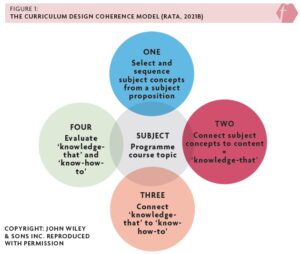
The model’s purpose is to enable teachers, as curriculum designers, to achieve a balance between three curriculum components: specialising concepts, coherent connections and cumulative knowledge structuring. It was this notion of ‘knowledge balance’ that particularly attracted us to the CDC Model.
Attending to forms of knowledge
Tim Oates’ paper ‘Could do better’ (2011) reviewed curriculum documents from a range of countries and recognised the significance of the interrelationships between ‘contexts’, ‘concepts’ and ‘content’. In our partnership of schools, we have drawn on these terms when considering curriculum design. We consider ‘context’ to be the motivating topic or theme used to engage learners. This could include drawing on the prior experience of learners and putting this to work in relation to a subject’s concepts. We understand disciplinary ‘concepts’ to be the organising and specialising ideas that ensure that each subject is distinctive. Each subject is made up of a unique combination of concepts. It is by paying close attention to the particular properties of conceptual knowledge that coherence and progression can be enabled. Content is made up of both ‘knowledge how’ (procedural knowledge) and ‘knowledge that’ (propositional knowledge).
While the notion of a concept is notoriously difficult to articulate, concepts are central to a subject, authentic in relation to its disciplinary architecture, and contestable, in that there is space for discussion and dialogue. Concepts therefore have a different role in curriculum design than that offered by more specific content. For instance, content can be atomised and performed, whereas the more open nature of concepts enables evaluation and reflection, which in turn enable connection, coherence and progression. In other words, concepts create the connections.
In order to be ‘powerful’, these connections need to be visible in the curriculum. They are made visible through the language that we use in our curriculum design. Consequently, subject concepts must be systematically named and repeatedly referenced if coherence and progression are to be facilitated. Unless named they cannot be ‘seen’, unlike visible performances or recalled information. So, for example, in physical education, when teaching the physical moves associated with different forms of rolling (forward, backward), the concept of space specialises the moves (through a focus on the significance of spatial awareness). The association between what is seen and how it is specialised would be missed if the learner was simply provided with a list of instructions associated with the physical actions involved in performing a roll. Referencing the subject concept, therefore, is essential if learning is to be specialised, organised and lifted out of its immediacy.
Curriculum dilemmas
As a community of teachers and teacher educators, we have come to appreciate that different forms of knowledge serve different purposes. However, we were conscious that while we appreciated the differences between curriculum assessment and pedagogic knowledge, we often couldn’t resist what Pountney (2020b) has termed the ‘pedagogic imperative’ – the predominance of concern for teaching over the careful consideration of curriculum sequencing (Spielman, 2018).
The CDC Model recognises the inner logic of subject knowledge – in other words, its epistemic structure – as the principle of curriculum design. Developed originally by the Knowledge in Education Research Unit (KERU) at Auckland University (Rata, 2021a), it has been subsequently developed with a wider academic team from KERU and communities of teachers in New Zealand (Rata and McPhail, 2020). The CDC Model creates curriculum coherence by identifying and sequencing different knowledge components. We implemented this model in relation to PE in the primary phase.
The example of physical education (PE)
Using the CDC Model
In conversation with the KERU team, it was clear that the New Zealand teachers had drawn upon the CDC Model sequentially (see Figure 1). Element 1 involved creating a statement (proposition) that encapsulated both the topic (in our case context) and subject concepts. The work from New Zealand recognised that generating the proposition statement is important for Element 1 because it states what the topic will mean to the students. Meaning is located in the relationship of concepts to the topic and helps to then determine the specific content. We were also fortunate to be able to draw on the work of Caroline Holder, a PE consultant who had begun to consider with us a range of concepts in PE. One early exchange addressed the topic of teaching a forward roll. We were able to relate this topic to the concept and significance of movement, and therefore the transferable potential of learning became accessible.
Concomitant with this approach is the necessity to hold the concept accountable. By this we mean the need to select specific content that relates to the specialising concept, reinforced in Element 2 of the model. By selecting movement and the forward roll, we have chosen to prioritise certain content. Leading on from this, Element 3 recognises that there are both performance competencies and judgment competencies. This enables learners, by means of Element 4, to be supported in recalling content (to know that to perform a forward roll, certain moves are required), to acquire the skill (the physical movements), and to know how to enact the roll (recall the content of the movements). Importantly, they are then able to evaluate not only how well they recalled and performed but also why the forward roll is an example of movement and why movement, or being physically active, matters. Teaching the forward roll in relation to movement is therefore significantly different to ‘just’ teaching a forward roll.
Conclusion and next steps
While our work is ongoing, there are clear indications that the CDC model has the potential to illuminate curriculum making in other subjects and phases. We are excited by the prospect that the Model may help us to resist the pedagogical imperative. We also suggest that the CDC framework will help us to avoid generating a curriculum that simply lists content and activities rather than also considering meaning, coherence and progression. We are looking forward to revisiting the significance of the relationships between the distinctive nature of curriculum, pedagogy and assessment, so as to develop an empowering curriculum for the benefit of our learners. This curriculum, for us, is one that pays due attention to knowledge structuring and one that develops an informed knowledge literacy for teachers and students.