
We live in times of accumulating crises. We are experiencing crises of democracy, inequality, energy, climate and pollution. This is a time for critically re-examining how we understand, frame and shape educational thinking – a time for repurposing and reimagining the role and work of teachers and leaders in the hopeful project of education. It is also a moment to ask students directly about their needs, to reimagine schools not as directive spaces, but as dialogical ones – spaces that are invitational and grounded in trust, respect, joy and openness. In Norway, for example, such an approach has informed the work of Gudrun Jonsdottir and Anne Kristine Byhring (2023), who argue that there is not one singular form of education for sustainable development. Rather, there are multiple educations, reflecting diverse conceptions of sustainability, each bringing distinct agendas and purposes.
Until now, technological advances have mostly been absorbed into our social worlds – changing them, but staying broadly within our expectations, values and tolerances. The fundamental threat of artificial intelligence (AI) is that, rather than adopting it as a tool to enhance our social and cultural lives, it will force us to live in a more narrowly constructed world of oppressive social norms. Classrooms should be among the spaces that move beyond merely knowledge-engaged or skills-led curricula. Instead, they should be sites of future-facing learning, where critical and creative thinking about the purposes of education drives how we access, motivate and engage all learners, each of whom brings diverse forms of knowledge to school. A school’s curriculum should present pathways into immersive, knowledge-rich and arts-rich worlds, in which learning communities can extend their knowledge far beyond their own local experiences. Classrooms can be places where learners and teachers join to collaboratively observe and co-create their worlds. As well as this, they are places in which to critically analyse the worlds that they inhabit.
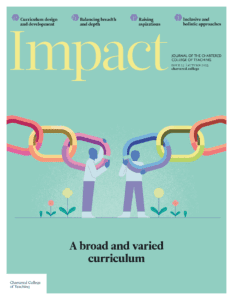
A curriculum is a living entity, involving different knowledge within different communities. In our view, it is – or ought to be – conversational and dialogic. As we emphasise in the Unlocking Research book series (Biddulph and Flutter, 2021; Burnard and Loughrey, 2022; Biddulph et al., 2023), and as supported in this issue of Impact, curriculum is not simply about content delivery; it is about crafting a purposeful, values-rich narrative that prepares all learners for a life of meaning, agency and contribution. To do so, we must look beyond the traditional and towards the transformational. This means reimagining curriculum, not only in what we teach but also in how and why we teach it. It means resisting standardisation and narrow metrics, and instead embracing powerful knowledge, pedagogical integrity and the emotional and ethical growth of every learner. Technology – including AI – may aid planning, but it cannot replace human judgment, empathy, inspiration or intent. In fact, the curriculum must assert our humanity more than ever, embedding oracy, metacognition and challenge, and always planning for misconceptions – not as failure, but as a gateway to deeper understanding. To future-proof education, we must become not only designers and creators of knowledge, but also curators of hope. We are the hopemongers (Halpin, 2003).
At the heart of this reimagining lies the principle of inclusionAn approach where a school aims to ensure that all children are educated together, with support for those who require it to access the full curriculum and contribute to and participate in all aspects of school life. A truly just curriculum reflects the lives and potential of all children, not just the dominant narratives. It empowers neurodivergent learners, embraces multilingualism and gives a voice to often-unheard minorities. A diverse curriculum is not an optional layer; it is foundational to high standards and deep engagement for all. This includes subject-specific innovation: from trauma-informed history to collaborative Year 7 writing, from inquiry-based science in special educational needs and disabilities settings to a national rethink of religious studies. The curriculum must attend to transition points too – Early Years Foundation Stage to Key Stage 1, Key Stage 2 to Key Stage 3, and beyond – ensuring coherence and continuity. Outdoor learning, experiential education and creative arts must no longer be sidelined. These approaches don’t just ‘enhance’ learning – they are learning. We must embrace observational drawing, multisensory drama, school STEAM (science, technology, engineering, arts and maths) gardens and the radical openness of performing arts that is crucial for self-expression, experimentation, cognitive development and fulfilment. Rewilding creativity is not a nostalgic luxury; it is a pedagogical necessity in the face of a mechanised, standardised, arguably dehumanising system. At every turn, we must ask: Who is this curriculum for? Whose knowledge is being centred? Which creativities are we educating for? What futures are being imagined? How are we holding space for possibility?
This issue of Impact makes it clear that we are standing at the threshold of societal and educational shifts. Gemma Gilvin emphasises the point in relation to climate change education – and what is needed to help this fit into the curriculum. James Leigh calls for curriculum experiences that include digital literacy, problem-solving, oracy and climate awareness, alongside continued support for creative, sporting and volunteering opportunities. What can be seen throughout this issue is that, in times of great uncertainty, teacher research really matters – research that builds on and produces a plurality of new creativities, knowledges, literacies and diversities that call for boundary-pushing practices.
Several authors have been involved with the Chartered College of Teaching’s groundbreaking Rethinking Curriculum project (chartered.college/rethinking-curriculum). In their introduction to the project, Emily Ranken and colleagues inspire new thinking for, and practices of, meaningful curriculum development.
Placing the arts where they belong – at the heart of a broad curriculum – is a case convincingly made by James Clements, while Pat Thomson and Christine Hall emphasise the importance of nurturing the skills of specialist teachers to create ‘arts-rich’ schools.
The need for bold decisions is described in Lauren Kearney’s article, showing how oracy in the primary curriculum has brought about significant improvements in outcomes for learners. With a different focus, Charlie Cutler and Beth Walker foreground a curriculum that attends to the representation of women and girls, expressing ways (and historic challenges) of meaningfully representing voices and experiences. Importantly, how they think and design their curriculum at United Learning aims to create an inclusive curriculum that can help to improve girls’ experiences in school and beyond it.
Further themes of representation are offered by Louisa Davies’s case to move beyond a perfunctory ‘tick box’ approach to diversityThe recognition of individual differences in terms of race, ethnicity, gender, sexual orientation, socio-economic status, physical ability, religious beliefs and other differences, while Kasia Glinka and Rebecca Ryman explain how a knowledge-rich curriculum is possible for students with a wide range of needs when the process is conducted with ‘moral clarity, strategic planning and inclusive pedagogy’. Stephanie Povey reminds us to aim high, especially for those students who struggle most in the mainstream and need alternative – but not lesser – provision. Khadeeja Batool offers alternative learning pedagogies that foster collective wellbeing, where ‘learning is seen as relational, situated and deeply embedded in cultural and ecological contexts’.
Age-specific foci are also given. We learn from Victoria Cook about new research into curriculum design at Key Stage 3 that improves student transition arrangements. An exciting new approach to adaptive primary curriculum design is introduced by Stephen Crinall. Similarly, Michiel Wils et al. evidence recent studies that develop a well-sequenced and knowledge-rich curriculum for the early years, with a different approach provided by Emma Lewry and Ellen Parker about continuous provision and play in Key Stage 1. And a whole range of further topics are covered in the online issue (my.chartered.college/impact).
The curriculum, if it is to be a democratic one, must make space for the social imagination – the capacity to ask what is, what was, what should be and what could be (Biddulph and Baldacchino, 2023). These questions invite different possibilities for co-authoring new curricula. There are many approaches that explore what education is for and which creativities should be nurtured, reframing how education is conceived and practised. All of this pushes the boundaries of how we describe what it means to be educated and how such educations are articulated in a world that is both changing and conflicted.
Although we live in times of accumulating crises, we are also living in times of accumulating hope in humans’ capacity to seek solutions, to bring light to darkness and to explore futures in innovative and creative ways. This issue of Impact contributes to the discourse and unearths new possibilities for what counts as research and its ‘use’ in education, how it unfolds and how it matters (Taylor et al., 2020). Each article, in its way, invites us to ask questions of how, what and why we teach. The authors offer up spaces of dialogue and possibility and, at the same time, ask what we are using to think about what matters. As Donna Haraway puts it in her book Staying with the Trouble (2016, p. 12), ‘It matters what matters we use to think other matters with; it matters what stories we tell to tell other stories with… It matters what stories make worlds, what worlds make stories.’