DR JANET RAMDEO
ASSOCIATE PROFESSOR IN EDUCATION AND HEAD OF INITIAL TEACHER EDUCATION, UNIVERSITY OF GREENWICH, UK
‘Who gets ahead?’ This question was the basis of a 12-month study conducted by Wilson et al. (2006) examining how the intersectional experiences of disability, age, ethnicity and gender affect teachers’ career prospects. Their findings painted a picture of structural and systemic inequities, biases and discrimination that served to hinder the career trajectories and professional development of women, racially minoritised, older and disabled teachers. Twenty years on, revisiting this same question provides a window through which to view how far the profession has progressed in understanding and challenging inequities that affect recruitment, development, progression, retention and diversity of pre-service and in-service teachers and educational leaders.
So, why should we be concerned about the equity of teacher education and development? Teachers play a central role in implementing inclusive education, making their preparedness for effectively teaching diverse classes and their feelings of inclusion and belonging within the profession crucial in moving forward equity agendas for learners. The work of Donath et al. (2023) acknowledges that the number of studies examining the correlation between teacher professional development and improved inclusive practices has risen in line with growing policy and legislative mechanisms that drive inclusive education. Their own meta-analysis of the effectiveness of inservice teacher professional development in supporting the implementation of inclusive education found that teachers’ knowledge, attitudes and skills were considerably improved with quality training, as should be expected. Worryingly, though, research has found that teachers who were most positive about inclusion also had the highest risks of burnout (Holmqvist and Lelinge, 2021). This experience of burnout may be an indication of the effect on teachers who face inequities themselves, being highly committed to challenging inequities for learners yet experiencing the unseen burdens of invisibility and underrepresentation. These inequities are exemplified through a range of studies, including the primacy of heteronormativity faced by LGBTQIA+ teachers (Horn et al., 2010), racially minoritised teachers being expected to undertake invisible work without recognition or compensation, which hinders their career progression (Ramdeo, 2023; Milner, 2020), and structural barriers that create gender imbalances and gender pay gaps at school management level (ASCL et al., 2021; Moreau et al., 2005).
A logical starting point to discussing inequities in teacher education and development is initial teacher education (ITE) for pre-service teachers. A literature review conducted by Neca et al. (2022) uncovered that some preservice training programmes failed to sufficiently accommodate the needs of trainee teachers with disabilities because providers do not understand their specific needs or are not adequately prepared to address them. They also found that pre-service teachers may fear the consequences of disclosure on their progress and raised concerns that providers may be specifically directing trainees with disabilities towards teaching in SEND (special educational needs and disabilities) provisions, thus maintaining invisibility in mainstream schools. Further, a different systematic review produced by Yip and Xu (2025) found examples of systemic racism and marginalisation in ITE experiences within a selection of 40 studies, noting that the dominance of whiteness was ‘embedded within the very fabric of teacher education programmes, which manifested through curriculum content, pedagogical approaches, and social interactions’ (p. 1693), impeding minoritised pre-service teachers’ sense of belonging and professional development.
In a positive move forward, Ofsted published its revised framework for ITE inspection in September 2025 with a renewed focus on inclusion, not just in terms of preparedness to teach diverse classes through the robust implementation of the Initial Teacher Training and Early Career Framework (DfE, 2024), but also in terms of evaluating the inclusivity of training provision. Its revised approach, implemented since January 2026, puts pre-service teachers first by breaking down barriers to access and ultimately raising standards, including for those identified with SEND and other identified barriers to their learning and belonging. ITE programmes should ensure that pre-service teachers are provided with initial teacher training and education that fosters safe environments in which to declare any needs, reduces barriers to their learning and development as future qualified teachers and makes any adaptations to meet their needs, and where pre-service teachers feel welcomed and valued regardless of their backgrounds or prior experiences. Additionally, the Scottish Council of Deans of Education launched a new national anti-racist framework for ITE in 2023 that aimed to attract, welcome and retain pre-service racially minoritised teachers, in line with government targets to increase representation. Meanwhile, in England, a similar anti-racist framework for ITE was produced, stemming from the work of Smith and Lander (2022), to raise cultural awareness and representation within ITE provision.
Once in service, how the profession retains teachers and aids their development and career progression becomes even more important, given the rhetoric about the teacher retention crisis. There are various factors that drive highly effective in-service teachers to leave, including workload and the way in which reduced funding has affected wraparound services, placing additional expectations on teachers’ roles and responsibilities. However, we need to consider whether inequities in teacher development and progression also play a role, where in-service teachers’ sense of belonging and wellbeing are important concepts in this conversation. Feelings of being invisible and underrepresented will inevitably affect teachers’ sense of belonging and wellbeing, and ultimately may have a negative effect on their development and progression in their careers, influencing their decisions to stay in the profession – or not. A scoping review by Wator et al. (2025) outlined The contributions recognise that more work needs to be done to investigate what mechanisms effectively reduce inequities in teacher education and development how enhancing teachers’ sense of belonging stems from fostering a positive school culture to support teachers’ identities and wellbeing, alongside challenging inequities that teachers face as potential barriers to their development and progression
Finally, when examining career progression and ‘Who gets ahead?’, a study by the Association of School and College Leaders et al. (2021) identified a clear gender pay gap differential at all career stages and a disproportionate gender imbalance at senior leadership levels. The report revealed that by the time women reach senior leadership positions, they could earn up to £17,334 annually less than men. The report also illuminated that despite men making up 13 per cent of primary teachers in the 2020/21 academic year, the number of men in primary headships doubled to 26 per cent. Even more starkly, in the 2020/21 academic year, men made up 34 per cent of teachers at secondary schools but 60 per cent of headteachers. A number of factors were suggested within the report as being barriers to women’s career progression, echoing some of the findings of Moreau et al. (2005), including the likelihood of family responsibilities being placed on women, thus influencing their contractual arrangements (for example, a third of women teachers in their 50s work part-time, reflecting possible caring responsibilities), and systemic issues, stereotypes and biases that can influence promotions and pay decisions, such as negotiated pay and women not receiving the same access to learning opportunities.
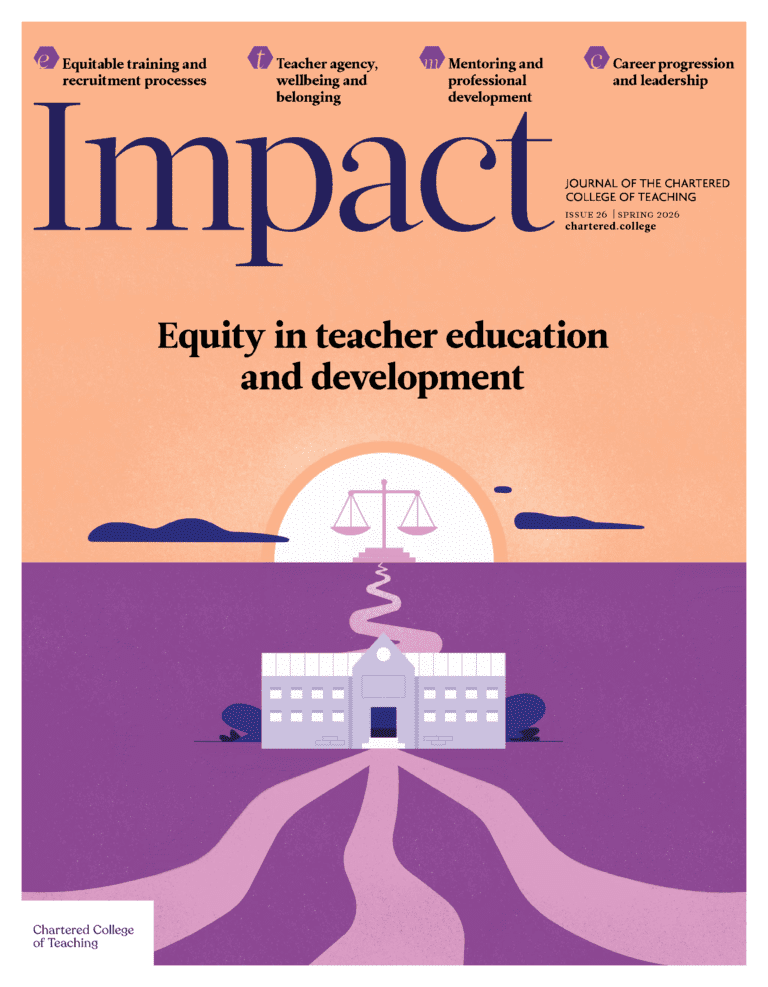
The discussion so far may present a picture of little movement forward in the last 20 years. Therefore, this issue of Impact presents antidotes – in the form of perspectives, original research and case studies – to some of the concerns raised in the literature and wider commentaries outlined in discourses and within this editorial.
Among the contributions on the theme of teacher recruitment and retention, Shalini Bhorkar, Robert Campbell and Juliette Claro remind us of the need to support international teachers as another community who are often overlooked, within both pre-service training provision and in-service development. Juliet Kotonya and Katherine Aston have researched mechanisms for tackling ethnic disparities in recruitment, retention and progression across teachers’ career paths. Retaining diversity in the workforce is critical, in terms not only of disability, ethnicity, age and gender but also of socio-economic status, making Clare O’Sullivan’s perspective on working-class teachers an important addition to the discussion of inequities in teacher education and development.
Mentoring is an important theme that is discussed in terms of wellbeing and belonging as well as professional development. Natasha Raheem provides a useful perspective on how mentoring through an equality, diversity and inclusion lens supports an increased sense of belonging, which can encourage greater levels of retention in the profession, while Gemma Molyneux examines how mentoring supports wellbeing in pre-service teachers by building resilience. In terms of professional development, Harroop Sandhu considers how mentoring and sponsoring differ and why both are important in tackling inequities, while Andrea Bean et al. discuss the use of coaching practices and Roxanne Lashley Allen considers reflective supervision in supporting racially minoritised staff.
Specific unseen groups and contexts are brought to the fore in the research conducted by Madelaine Best, who presents practical steps to aid teacher-mothers to successfully navigate the return-to-work phase, as well as Rebecca Underwood’s contribution to championing the visibility and professional development of Early Years educators. Academisation has seen the growth of large-scale cross-phase education provision under multi-academy trust umbrellas, but Aimée Tinkler and Richard Jackson remind us that, even within individual small schools, inequities need to be challenged. Broader reflections on representation are presented by Laura Evans and Kerry-Ann McNamee-Obi, who discuss the power of representative leadership, and Nicole Ponsford, who posits that seeing ourselves in our profession advances teacher development and leadership.
The contributions in this issue of Impact underline how there is room for innovative approaches to tackling inequities that teachers at all career stages face. The contributions also recognise that more work needs to be done to investigate what mechanisms effectively reduce inequities in teacher education and development, particularly at a time when equity, equality, inclusion and diversity are seemingly under threat, with shifting political discourse. Perhaps the question that we should be asking is not ‘Who gets ahead?’ but rather ‘How can we ensure that all staff get ahead?’
*A note on language in this issue: We acknowledge that terminology used regarding ethnicity and protected characteristics is a sensitive and personal matter, and therefore such language is used at the discretion of authors. We also acknowledge that such language is continually evolving, and in light of this, we encourage authors to explore the rationale for different terms where relevant to their subject matter.