
Alex Galvin, Senior Education Lead, SSAT (The Schools, Students and Teachers Network), UK
The increased focus on inclusion and adaptive teaching has prompted much discussion about the practical steps that teachers might take to enable all learners to thrive. The reality is that it will always be challenging to support the progress of children with differing needs simultaneously. When it is done successfully, as it is in many classrooms, it is a testament to the skill of that teacher and the relationships that they have established with their students.
It is difficult to provide definitive answers to the challenge of meeting the needs of all learners. The context of every school is different, and each has its unique blend of learners and teachers, all of whom bring their own individual mix of strengths and challenges. Many interventions are highly nuanced, meaning that even if something proves very successful in one place, it may be impossible (or not desirable) to replicate it elsewhere.
The search for definitive answers becomes considerably more challenging when we are talking about learners with special educational needs and disabilities (SEND). As any teacher or parent of a young person with SEND knows, it is rare to find something that consistently ‘works’; the best that can often be achieved is ‘might work, sometimes’.
Generalising about any group of learners is problematic, but it goes without saying that ‘learners with SEND’ describes a hugely varied population. People with a shared diagnosis can present in dramatically different ways. Added to this, the needs with which young people with SEND present may vary considerably day to day and hour by hour. And, of course, those young people may be less able to articulate their challenges and needs than other children.
There can be a tendency to make assumptions about particular groups of people – from personal experience, it is striking how often people with Downs syndrome are described as ‘loving and musical’ and it is assumed that autistic people love routine and are unable to tolerate loud environments. Those stereotypes are often framed positively and said with good intentions but nevertheless can result in limiting or inaccurate judgements.
Research and specialist support have an important role to play in helping us to better understand the needs of young people with SEND. We might learn, for example, that young people with autism may benefit from visual instructions, need more time to process verbal instructions and feel that it is very important to know what the plan is. This is important and helpful information. However, the word ‘may’ is crucial. While these might be recurring themes, this does not mean that it is true for every child in every situation.
We can learn from what research tells us, but this does not detract from the fundamental importance of seeking to understand the needs of different individuals and respecting the professional judgement of teachers.
What we are seeking to do in practice is to draw together different components, developing our understanding of the learner, while acknowledging that the different puzzle pieces are unlikely to come together in a neat and predictable pattern.
Where does this leave us?
The person at the centre of provision
Often, the most helpful starting point is the individual learner. What helps? What do they find difficult? These conversations can highlight practical steps that could be taken, help us to manage potentially challenging situations proactively and, importantly, show the young person that their views are valued and respected.
Similarly, the knowledge of parents and carers can help to develop an understanding of that child’s needs. Young people may present very differently at school to elsewhere, but these conversations help to build a rounded picture of the individual and identify strategies that may be beneficial.
Knowledge of different conditions
It is important to understand different conditions and diagnoses, including the ways in which these impact on an individual’s learning. As already explored, we need to avoid generalising about the needs of groups of learners, but it can help us to identify strategies that might be beneficial. This may provide us with ideas to try – or to run by the learner and their family. Understanding key research relating to particular conditions can play an important role in recognising the realities of a young person’s experience.
Respect lived experience
It can be difficult to develop an evidence base for particular strategies, because circumstances around any individual are inevitably highly nuanced. Clearly, it doesn’t make sense for time and resources to be given to approaches that don’t work – but we need to listen if learners, their teachers and their parents tell us that something is helpful. Whether we are talking about fidget toys or coloured overlays, if that student finds it helpful and it isn’t causing a problem for anyone else, then it makes sense to respect the judgement of the learner and their teacher.
Assess, plan, do, review
The graduated approach continues to provide the central reference point for ensuring that learners with SEND are supported. It emphasises the importance of maintaining an ongoing conversation about how a learner can best be supported, and recognises that their needs are continually changing. It highlights the importance of reflecting on the efficacy of different approaches and using monitoring to support ongoing improvement. Our recent article (Galvin et al., 2026) suggests that adaptation might be thought about in three stages: proactive adaptation (adaptations for which we make provision in our planning), interactive adaptation (adaptations made on the basis of what is happening in the moment, largely shaped by formative assessment) and retroactive adaptation (using learning from the lesson to inform ongoing curriculum design and lesson planning). This stresses the importance of an ongoing cycle of review and reflection, rather than a focus on particular strategies.
The importance of ‘why’ and ‘how’
Most strategies have the potential to be done well or badly. Again, this is a complexity that needs to be considered in any attempt to define ‘what works’. For example, there is a world of difference between a learner working on their own in a corner using adaptive technologies and a classroom where adaptive technologies are available to all. Strategies are much more likely to be successful when teachers and learners feel empowered to make informed choices about the approaches they want to take, and have a confident understanding of why they might be beneficial. Where approaches start from exploration of ‘why’ and ‘how’, they also support more meaningful evaluation of whether they have had the intended impact.
Similarity as well as difference
It is easy for discussion around SEND to focus on what we need to do differently. And, at times, certain young people do need different support. However, key areas of practice, such as classroom communication, formative assessment and modelling, are fundamental for all learners. There are approaches that may be particularly beneficial for learners with SEND, but also helpful to everyone else – for example, sharing the plan for a lesson or having some consistency in terms of lesson structure.
Culture matters
Effective provision is about much more than interventions to support an individual. The most inclusive schools have invariably established a culture in which difference is celebrated and there is a broad view of success. Inclusive schools have a culture in which all members of staff have positive attitudes about the potential of all learners to succeed, and who recognise that progress is rarely linear.
This supports an environment in which learners with SEND do not attach a sense of shame to their learning needs, and feel confident advocating for themselves. Learning is not only transactional and pedagogical; it is also relational and transformational. Progress is founded on trust and psychological safety. All learners (and teachers) are more likely to thrive where they are happy and feel that their views are valued and they are recognised for what they can do.
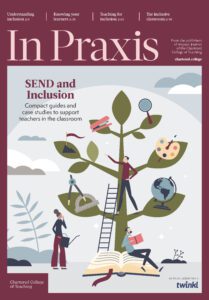
Read more from In Praxis: SEND and Inclusion