
OMEHRA MAHMOOD AND ANNA NELSON, AMBITION INSTITUTE, UK
Introduction
Belonging is a fundamental human need. Feeling accepted, valued and connected to others is central to motivation, wellbeing and performance (Baumeister and Leary, 1995). However, only 63 per cent of students in the UK report a sense of belonging, compared to around 75 per cent across similar countries (OECD, 2023). This article argues that belonging is shaped by structural and cultural conditions, and without addressing these, efforts to improve belonging may remain limited. The article draws on Bronfenbrenner (1995, 1997) to understand how belonging is shaped across multiple influences, Allen et al. (2016) to consider how schools can actively cultivate it and Johnson (2026) to examine how wider systems and inequalities influence who gets to belong.
Defining belonging and considering what works in schools
Research consistently shows that teacher–student relationships are key in supporting belonging (Allen et al., 2018; Anderman, 2003; Garcia-Reid, 2007; Johnson, 2009). The quality of these relationships – shaped through responsiveness, consistency and emotional support – can predict engagement and participation (Pianta et al., 2012). While the quality of teacher–student relationships remains central to belonging, some researchers argue that this conception may be incomplete, as belonging is not only an internal feeling but is also shaped by social, cultural and organisational forces (Kuttner, 2023; Johnson, 2026). Evidence suggests that belonging varies systematically across student groups (OECD, 2023), and this helps to explain why belonging is not experienced uniformly. For example, Archer and Francis (2006) draw attention to ways in which identity, race and school culture can shape educational experiences, with implications for how belonging is experienced. Students from disadvantaged backgrounds are more likely to face barriers to belonging (Goodenow, 1993; Wang and Eccles, 2013), and belonging can be more uncertain for students who are negatively stereotyped, underrepresented or historically marginalised (Walton and Cohen, 2011). Racially and ethnically minoritised students and those facing multiple, intersectional forms of marginalisation can encounter additional barriers and have fewer opportunities to belong (DeCuir-Gunby and Johnson, 2025; Gray et al., 2020).
Going further
If schools fail to attend to wider social, cultural and organisational conditions, then they risk missing patterns and institutional cues of exclusion, meaning that some students consistently feel less safe, valued or included (Johnson, 2026; Matthews et al., 2024). If we think about improving student belonging with social, cultural and organisational concepts in mind, then schools may be able to build a more holistic and equitable view of belonging by considering wider school forces that influence how school is experienced across students. This is not to say that existing approaches prioritising student–teacher relationships aren’t key – more that we can strengthen ideas around belonging when combined with structural perspectives that also consider routines, systems and cultures through which belonging is experienced.
A broad, equitable approach to improving student belonging might also support schools to go beyond one-off interventions or discrete initiatives, such as themed weeks, one-off CPD (continuing professional development) sessions or belonging-themed displays. These risk feeling imposed, tokenistic or disconnected and, if they do, won’t reshape underlying cultures in the long term. Instead, we can build equity and belonging into the design of school systems when developing behaviour policies, curriculum or assessment approaches. Leaders might ask: Which students is this most likely to work well for? Whose experiences or circumstances are being considered in this design and whose might be overlooked? How might this be experienced differently by students who do not see themselves reflected in the norms or expectations being established? Supporting belonging thus becomes part of everyday practice and an ongoing, evolving process.
Supporting this work
Bronfenbrenner
If belonging is shaped not only by relationships but also by wider structural factors, then how might schools foster equity and strengthen belonging in response? Bronfenbrenner’s ecological model (1995, 1997) offers a useful starting point, showing how different parts of a student’s life and environment interact. Central to this model is the idea that a young person’s development is shaped not only by the individual and relationships but also by systems and wider social conditions around them (Bronfenbrenner, 1997). These systems can be understood at several levels:
- microsystem: ‘activities, roles and interpersonal relations’ experienced in immediate settings (e.g. home, school, playground) (Bronfenbrenner, 1979, p. 22)
- mesosystem: ‘interrelations among two or more settings… in which the developing person actively participates’ (e.g. home, school, neighbourhood) (Bronfenbrenner, 1979, p. 25)
- exosystem: settings that ‘do not involve the developing person as an active participant’ but in which events still affect their immediate environment (e.g. parent’s workplace, class attended by a sibling, parents’ network) (Bronfenbrenner, 1979, p. 25)
- macrosystem: wider cultural and social context – broader ‘consistencies’ across lower-order systems, including underlying ‘belief systems or ideology’ (e.g. cultural values, socio-economic differences, ethnic and religious group norms) (Bronfenbrenner, 1979, p. 26)
- chronosystem: how these influences change over time (e.g. family changes like divorce, pandemics, wars) (Bronfenbrenner, 1997).
Allen et al.
While Bronfenbrenner’s model is helpful in broadening understanding of how student experiences are shaped by multiple interacting environments, it doesn’t specify what educators can do in practice. Allen et al. (2016) address this by building on Bronfenbrenner’s model (1997) to develop a socio-ecological framework focused on belonging in secondary schools, alongside evidence-informed strategies for a range of practitioners, including educators, school leaders and school psychologists. They suggest that this creates ‘a classification system… [that] will shed light on which layers within the schools should be prioritised’ in efforts to strengthen belonging (Allen et al., 2016, p. 99). Viewed as a practical framework, it may therefore help schools to identify what affects a student’s sense of belonging, consider what helps or hinders, and target action across multiple levels. This doesn’t mean that schools need a framework to ask such questions, but it can help them to do so more systematically.
Allen et al.’s (2016) evidence-informed strategies focus on the individual, microsystem and mesosystem levels of their framework. This article is particularly concerned with how school systems and structures shape belonging, so mesosystem-level recommendations are especially relevant. At the mesosystem level, Allen et al. (2016) bring together a range of school practices associated with belonging and extend beyond visible areas such as behaviour policy to include school vision, staff PD, wellbeing, connectedness, curricular/extracurricular opportunities, and engagement with students, families, staff and the wider community.
The framework and strategies support a reflective mindset that helps educators to consider how different aspects of schooling combine to shape belonging and think more holistically and systematically about the factors that shape it. This can broaden professional thinking beyond the idea that belonging is only about individual students’ confidence or relationships, and instead frame it as a whole-school responsibility. For example, when reviewing behaviour policy, leaders might ask whether some students are sanctioned more often or more harshly than others. They might draw on student voice to build a fuller picture of student experience and use PD to help staff to examine patterns of discrimination and sanctions, alongside developing fairer and least-invasive responses. Allen et al. (2016) also offer an evidence-informed starting point by drawing together relevant literature, reading, additional frameworks and programmes to support educators. Used reflectively, this may support schools to review existing provision, identify gaps and consider highest-leverage actions.
Johnson
Johnson (2026) critically synthesised recent theoretical and empirical developments on belonging in higher education in an effort to move beyond individual-level and interpersonal understandings of belonging. Using Bronfenbenner’s (1997) ecological model, Johnson developed the Intersectional Ecological Belonging Model (IEBM), which brings intersectionality and ecological systems theory together to highlight how layers of racism, sexism, classism and ableism interact to shape the lives of higher education students (Johnson, 2026; Figure 1). The model traces how ‘interactions within classrooms and advising relationships, cross-unit coordination, institutional policies, and national ideologies collectively produce uneven conditions of belonging – conditions that are especially consequential for students whose identities sit at multiple margins’ (Johnson, 2026, p. 1). The IEBM emphasises that layers interact – for example, macro-level structures influence micro-level experiences. One example given is ‘a faculty member overlooking a Black woman’s contributions in STEM, or an advisor discouraging a first-gen student from study abroad due to finances’, which ‘are not simply interpersonal slights. They are micro-level enactments of structural logics that cascade through ideology, policy, and practice.’ (Johnson, 2026, p. 10) Put simply, experiences that appear personal or isolated may reflect wider systems and inequalities operating through everyday school life, which we can affect.
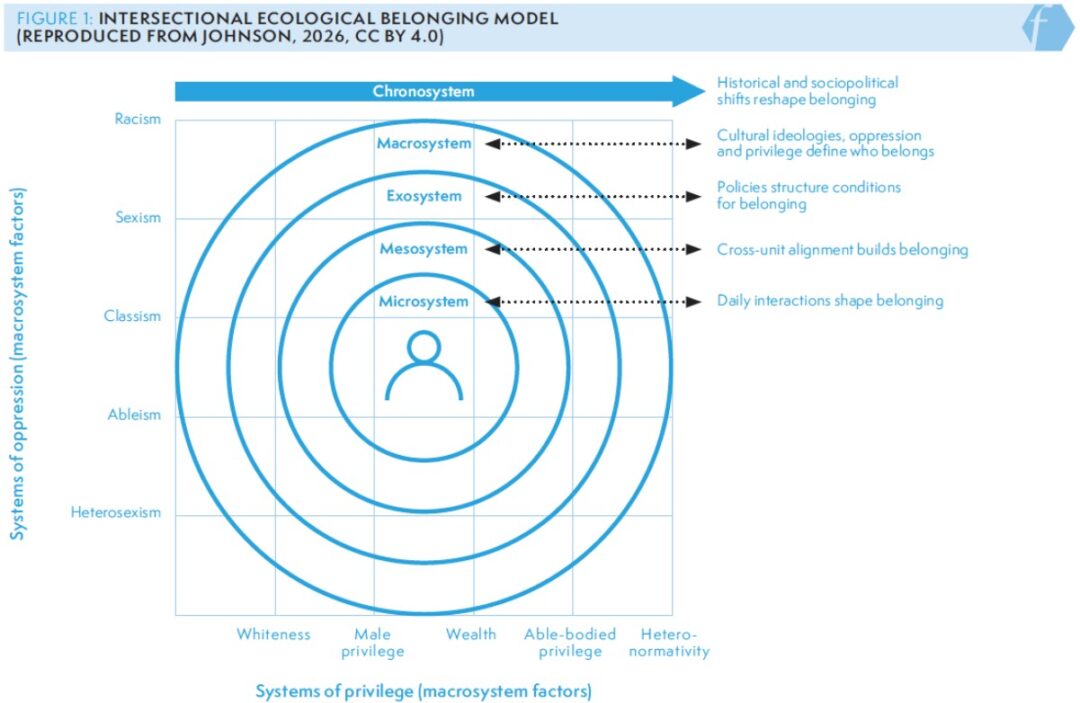
Figure 1: Intersectional Ecological Belonging Model (Reproduced from Johnson, 2026, CC BY 4.0)
How might this support leaders and teachers? Johnson (2026) gives examples of factors that shape belonging at the microsystem, mesosystem, exosystem and macrosystem layers. He also shares what this might look like for students with intersecting identities. Johnson’s work supports us to consider different student perspectives and barriers to belonging from the outset, and to design policies and PD with these in mind.
Conclusion
Taken together, the work of Bronfenbrenner (1997), Allen et al. (2016) and Johnson (2026) suggest that students’ experiences of belonging are shaped by multiple, interconnected systems within and beyond school. For schools, this means:
- Relationships matter, but they’re not enough. Teacher–student relationships (microsystem) are important, but they are influenced by wider factors like family circumstances, school policies and cultural expectations. Alongside investing in relationships, schools might review whether wider systems help those relationships to develop or make them harder to sustain.
- Home–school connections are significant. Strong communication and trust between families and schools (mesosystem) can support belonging and engagement. Schools might ask whose voices are heard most easily, which families feel least connected and how communication can become more trusting, accessible and reciprocal.
- Policies and structures shape experience. Behaviour systems, curriculum choices, timetables and inclusion practices (exosystem/macrosystem influences) can strengthen or weaken belonging. Schools might ask whether these systems create fairness, participation and safety for all students, or whether some routines unintentionally make belonging harder.
- Context matters. Students from different backgrounds may experience school differently depending on race, class, gender, disability or prior experiences, and depending on how these identities intersect. An intersectional lens may help schools to design initiatives for students who face greater barriers to belonging and to reflect on whether systems work equally well for all groups.
- Belonging changes over time. Transitions, life events and school change (chronosystem) mean that it might help schools to view belonging as ongoing, and not something fixed.
To conclude, schools should ask not just ‘How do we help this student to belong?’ but also ‘How is our environment shaping whether belonging is possible?’.