BETHANY HOWES, SUBJECT DEVELOPMENT LEAD (SCIENCE), TEACH FIRST, UK
Introduction
Research consistently shows that effective teaching depends not only on strong subject knowledge but also on the ability to represent and communicate that knowledge in ways that make it learnable for pupils – what Lee Shulman (1986) defines as pedagogical content knowledge (PCK). Consequently, developing teachers’ subject-specific pedagogy (SSP) should be a core focus of professional learning. Reviews of teacher development consistently demonstrate that subject-specific CPD (continuing professional development) has greater impact on both classroom practice and pupil attainment than generic approaches (Desimone, 2009; Cordingley et al., 2015, 2018). Robert Coe (2020) further argues that subject-specific CPD is one of the most cost-effective school improvement strategies, particularly when it is sustained, embedded in classroom practice and focused on the nuances of disciplinary teaching.
Despite this strong evidence base, access to high-quality subject-specific CPD remains limited. Schools face persistent structural barriers, including time constraints, workload pressures, funding limitations and uneven access to subject expertise (Coe, 2020). Even where expertise exists, deploying expert teachers as coaches can be difficult without removing them from their classrooms. As a result, CPD is often fragmented, one-off or disconnected from day-to-day practice, limiting its impact.
This case study describes a response to this challenge by exploring an innovative video-based approach to developing subject-specific pedagogy.
Origins of the approach
This approach was initially developed within a secondary science department facing common subject-specific CPD challenges. Teachers were required to teach across all three sciences, often outside their specialism, with topic rotations meaning that content was not always taught concurrently. As a result, subject-specific CPD was often poorly timed or insufficiently targeted to individual needs.
To address this, a video-based model was introduced to provide flexible access to expert explanations of conceptually challenging topics. Experienced practitioners recorded short ‘how I explain…’ videos, modelling pedagogical approaches such as dual coding, use of practicals, modelling and strategies for checking understanding. These videos were directly saved into topic folders as a shared resource and were expected to be used during lesson planning, embedding CPD within everyday practice.
To avoid unfocused engagement with videos, a dual lens approach was introduced, supporting teachers to develop subject knowledge while analysing pedagogical decisions. Early qualitative evidence indicated increased confidence and greater consistency in explanations, particularly for ECTs (early career teachers) and teachers teaching outside their specialism.
The dual lens approach
A key development was encouraging teachers to adopt two distinct lenses when engaging with the explanation videos. This approach emerged from reflections on my own practice – I would often watch educational videos on platforms such as YouTube to develop my own subject knowledge, alongside using the Laurus Trust’s ‘explanation videos’ to reflect and identify ways in which to improve my pedagogical approaches to teaching a concept. Combined with the ‘what to teach’ and ‘how to teach it’ framework underpinning Lee Shulman’s (1986) concept of pedagogical content knowledge, these insights informed the development of a dual lens approach.
- The ‘learner lens’ – developing subject knowledge: This lens is particularly useful for teachers teaching outside their specialism. Teachers were encouraged to watch the ‘How I teach’ explanation videos through a learner lens, answering the questions asked to self-assess their knowledge and developing a deeper understanding from engaging with the video.
- The ‘practitioner lens’ – developing PCK: The teacher would rewatch the video, this time focusing on how knowledge is disseminated by the teacher, what pedagogies they employ and how they check for understanding. The idea is that they then reflect on how similar explanations could be executed in their own classroom, potentially writing scripts and practising them prior to the lesson.
This dual lens model addressed key barriers by embedding CPD within everyday planning, providing flexible access to expert modelling and offering a cost-effective approach that reduced time and staffing demands. However, initial reflections identified the need for scaffolded reflection tasks to be created to support the dual lens approach while teachers were watching the videos. This would hopefully enable deeper, independent pedagogical analysis without the need for direct expert facilitation.
Dual lens approach in initial teacher education
The Subject Development Lead role at Teach First is primarily focused on developing both subject knowledge and PCK for participants on our trainee programme. Trainees and ECTs already have access to a range of support, including bespoke subject-specific focused development interactions, seminars, training days and coaching, but a gap remained in providing asynchronous, on-demand opportunities to develop subject-specific expertise.
At the same time, across the country and sector, increasing reliance on shared resources risked encouraging trainees (and more experienced teachers) to deliver materials without fully engaging with the subject content or pedagogical decisions. Without opportunities to analyse the expert explanations and decision-making that went into planning centralised resources, trainees and ECTs could miss opportunities to develop crucial components of PCK and lesson-planning skills.
Initially, a lack of high-quality video resources posed a barrier. To address this, science lessons from Oak National Academy were used. These videos feature experienced teachers delivering research-informed lessons, drawing on work from groups such as the University of York Science Education Group. This provided trainees with rich, research-informed exemplars with which to engage through both lenses.
To formalise the approach, a new curriculum strand, Pedagogy in Practice (PiP), was introduced in the science curriculum. As part of their asynchronous curriculum, trainees engage with research linked to a half-termly pedagogical focus, such as addressing misconceptions, supporting language and literacy, or designing purposeful practical work.
Trainees then select an Oak lesson (biology, chemistry or physics) that exemplifies this focus, with trainees selecting the lesson topic that aligns to their own subject knowledge gaps. They first watch the lesson through a learner lens to deepen subject knowledge, before revisiting selected sections through a practitioner lens. The practitioner lens is supported by PiP deliberate practice tasks, which require trainees to analyse pedagogical decisions, anticipate misconceptions and consider how approaches can be adapted in their own teaching. An example of a PiP task is shown in Figure 1.
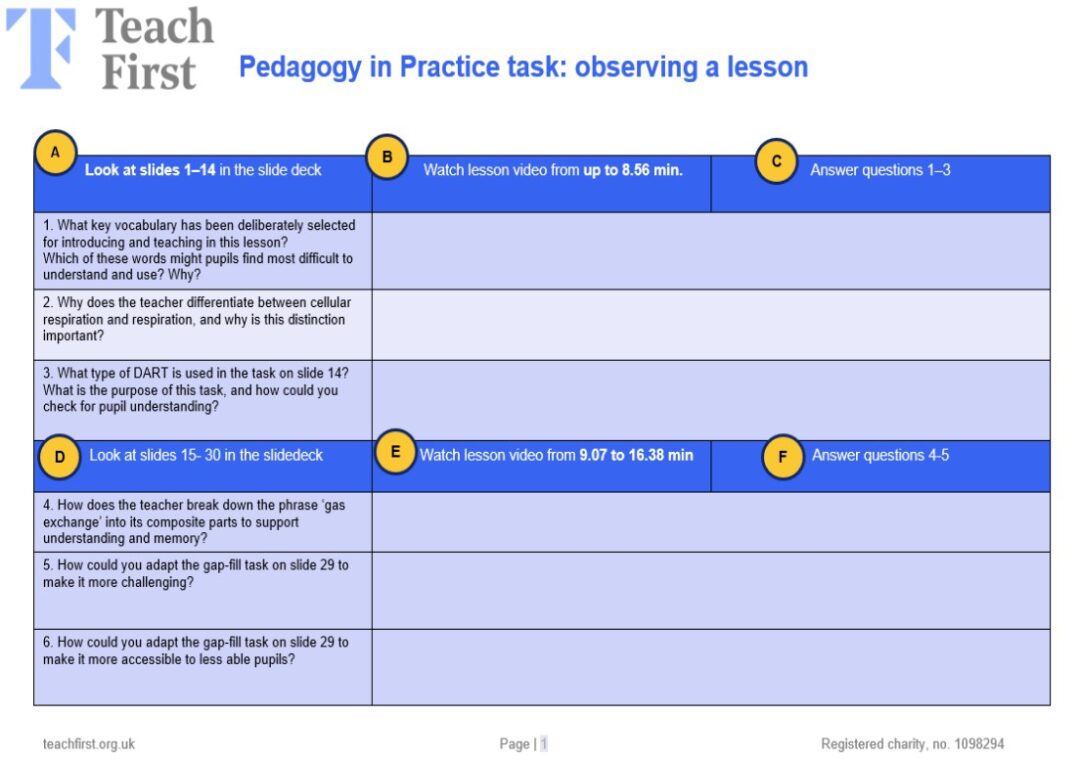
Figure 1: Example of a PiP deliberate practice task focused on the use of Directed Activities Related to Text (DARTs) to support students in identifying and applying tier 3 vocabulary in context (Copyright Teach First)
Importantly, trainees are encouraged to view Oak National Academy resources not as ‘off-the-shelf’ lessons but as adaptable models, mirroring how shared curriculum resources should be used within their own school contexts. These scaffolded tasks were introduced following early reflections that structured guidance was needed to support independent use of the dual lens approach, particularly given evidence that novice teachers require explicit support to interpret expert practice (Coe et al., 2014; Coe, 2020).
Initial feedback
Feedback is currently being collected and analysed through termly trainee questionnaires capturing both quantitative and qualitative data on experience, subject knowledge, PCK and classroom practice. Data collection is ongoing to refine and evaluate the approach. So far, trainee feedback has been positive. Examples of trainee feedback include:
Watching the Oak lessons with a more analytical lens made me focus not just on what was being taught but how and why. It’s made me far more mindful of the explanations I give in my own lessons.
Honestly, I think this was super helpful as it is a topic I haven’t covered in a while and I am teaching it in the first week back after Christmas! My genuine key takeaway is to watch these [Oak] lessons on topics that I am not as strong in, as it gives me a far better understanding and provides some inspiration.
I feel better equipped to teach this topic to my pupils now after completing the PiP task and watching the Oak video as I feel I have picked up on some techniques in address[ing] misconceptions around breathing and respiration and how to efficiently teach them gas exchange so they can understand.
These responses suggest that the approach supports both subject knowledge and PCK development, while promoting more deliberate and reflective teaching.
Conclusion
This case study suggests that an innovative ‘dual lens’ video-based approach may overcome key barriers and challenges to subject-specific CPD by providing flexible access to expert modelling and embedding learning into practice. While evidence is still being gathered, initial feedback points to this approach’s potential to develop subject knowledge and PCK, enabling teachers to recognise, analyse and apply expert pedagogy more consistently.