MARIA GUERRA SAPPHO, UNIVERSITY OF HUDDERSFIELD, UK
KIRSTIN MACVICAR, UNIVERSITY OF CAMBRIDGE PRIMARY SCHOOL, UK
PAMELA BURNARD, UNIVERSITY OF CAMBRIDGE, UK
FRÉDÉRIC DUFEU, UNIVERSITY OF HUDDERSFIELD, UK
MICHAEL CLARKE, UNIVERSITY OF HUDDERSFIELD, UK
In primary education, understanding human/nature relationships requires doing more than introducing children to works of art that are inspired by nature. Nature is not ‘out there’; it is something experienced in the same way that culture is constructed and experienced (Diffey, 2001), wherein the relationship between learning, culture and nature shifts and merges. Whether we attune ourselves to what Dewey (1928) acknowledged as the potential of gardens for learning, or to nature and the sounds of water drops pooling, songbirds and leaves rustling in school gardens, the connection between outdoor learning and physical space and place requires us – as educators and as residents of Earth – to strive, as Gray et al. (2021, p. 148) argue, ‘towards a relational pedagogy that encourages children to recognise how important our thinking and our behaviours are to the health of the only planet we have, and ultimately to our own health and wellbeing’.
This article presents a collaboratively developed study from the Digital Playgrounds for Music (DPfM) project (University of Huddersfield, nd), examining how listening-led, sound-based technologies support creative, cross-curricular, place-based learning in primary education. A classroom activity with three Year 6 classes at the University of Cambridge Primary School used the Listening Playground web app, with Figure 1 outlining key listening-led learning areas for teachers. The project generated student recordings, images, sound maps and reflections, alongside teacher reflections and researcher observation, forming a listening-led practice in which sound functioned as material for inquiry. ‘Sound as material for inquiry’ looks like children investigating how places, materials and bodies shape and sense sound, recording, comparing and mapping what they hear (see Cook et al., 2023, for more examples related to ‘body sensing’). Listening served as the primary investigative mode, positioning students as active agents shaping process and outcomes, while collaborating, making cross-curricular connections and using technology creatively, inclusively and reflectively. A video walkthrough, lesson plan and link to the free web app are provided at the end of this article as practical resources for educators, who are encouraged to explore them with attention to how listening structures the learning process.
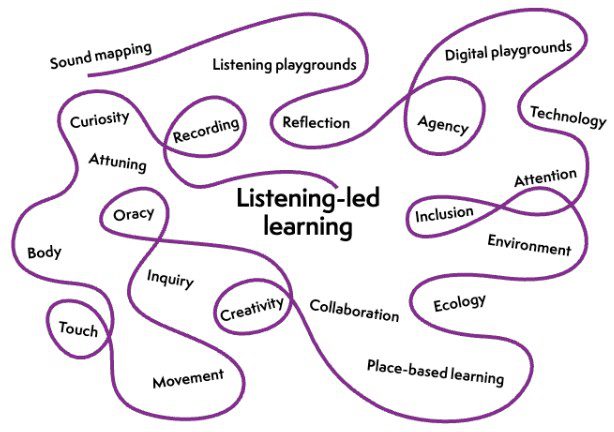
Figure 1: Rhizomatic diagram of listening-led learning, highlighting the interconnected roles of sound mapping, digital tools, embodiment, environment, inquiry and collaboration in classroom practice
Music as sound: Listening, technology and digital playgrounds for music
Contemporary classrooms require students to work across subjects, develop digital literacies and engage critically with technology. As ‘many of the children entering education today will be living into the next century’, questions are raised about how education might cultivate curiosity, adaptability and critical engagement with the world (Burnard, 2025). DPfM addresses this context by using listening-led, sound-based activities to support cross-curricular inquiry.
Developed through collaboration between the University of Huddersfield, the University of Cambridge Faculty of Education and classroom partners, DPfM explores how sound technologies can function as tools for cross-curricular learning. DPfM reframes music as environmental sound and listening as an active mode of inquiry, drawing on interactive aural analysis (Clarke et al., 2020), school soundscape and sound-mapping practices (Sciuchetti, 2025), and posthuman perspectives that understand learning as emerging through engagement with materials, environments and technologies (Taguchi, 2011; Burnard and Köbli, 2024). Together, these perspectives position listening as situated, cross-curricular inquiry, grounded in observation, reflection and place.
Listening-led practice in action
This section examines the listening-led activity, using student recordings, photos, reflections and teacher observations to trace how listening, recording and discussion developed.
Children as researchers
An important aspect of Listening Playground is that it positions children as researchers, placing the tools of inquiry directly in their hands. Students determined what to notice, how to document it and how their findings related to place, meaning that the material discussed here is shaped by their priorities, imaginations and social relationships.
Involving students in research-like activities not only provided autonomy within the lesson but also reinforced the idea that they have agency in their learning more broadly.
Kirstin MacVicar, UCPS Year 6 teacher, 2026
Students’ decisions about recording, describing and organising sounds in shared maps demonstrate developing methodological awareness. Their reflections show that they were not simply collecting sounds, but recognising how outcomes shift with material, context and technology, and how recording tools and individual choices shape what is heard and represented.
I liked how we all made completely different sounds and even if we used the same material, the outcome was always different.
UCPS Year 6 student, 2026
It was cool that we could change how much sound the microphone recorded and it showed the pitch, volume and timing.
UCPS Year 6 student, 2026
Teacher reflections reinforce this shift in classroom roles, noting that involving students in research-like activity strengthened their sense of agency in learning.
When given a voice, children have ideas about their education that need to be listened to.
Kirstin MacVicar, UCPS Year 6 teacher, 2026
Collaboration, perception and autonomy
Working in small groups, students supported one another in listening closely, comparing recordings and articulating what they were hearing.
Creative work inherently involves vulnerability, as students are asked to share ideas that may feel personal or uncertain. When encouraging creativity, it is essential that children work in environments where they feel safe, respected and valued.
Kirstin MacVicar, UCPS Year 6 teacher, 2026
Within these groups, perception became a collective activity, as students compared recordings, discussed small sonic details and speculated about how different materials might behave sonically across contexts. Autonomy was a defining feature of the activity’s structure. Students were given responsibility for deciding where to record, what to capture and how to organise material.
Providing children with iPads and allowing them to work independently around the school can be daunting, particularly when the task is open-ended. However, the children remained focused and purposeful, even when working without direct adult supervision. They knew the importance in what they were doing, in terms of sound collection and research, and this acted as a motivator.
Kirstin MacVicar, UCPS Year 6 teacher, 2026
Students’ own written reflections reinforce this observation. Many described enjoying the sense of freedom to explore, choose what to record and decide how to listen. This repeated emphasis suggests that autonomy was not only a structural condition of the activity, but also an explicitly felt and articulated aspect of students’ experience.
I liked the freedom and I liked the fact that we got to record our own sounds.
UCPS Year 6 student, 2026
I enjoyed being free and having fun making funny sounds.
UCPS Year 6 student, 2026
Sound names, tags, and maps and images
Across the 443 sounds recorded, the language that students used to name their recordings shows varied ways of understanding sound. Some titles were source-based (‘birds chirping, bark, clap’), others described actions (‘screech or hitting’) and some emerged from humour and social interaction (‘Joseph’s nose, conversation and Swarangi’s watch’), suggesting that sound was treated as environmental, social and expressive.
It was particularly insightful to observe the different approaches students took to sound collection and to listen to their discussions about meaning and interpretation.
Kirstin MacVicar, UCPS Year 6 teacher, 2026
The app encouraged exploration of varied sonic qualities by prompting students to seek high, low, steady, repetitive, loud or quiet sounds.
I also liked the fact that you got badges if you got certain sounds, as that encouraged you to find different varieties of sounds and to discover how they were.
UCPS Year 6 student, 2026
Photographs taken alongside recordings show students producing sound through movement and touch, documenting gestures as well as sound sources. These images suggest that sound is not simply located in objects, but emerges through interactions between bodies, materials and environments. The visual documentation foregrounds children’s sensing bodies (Cook et al., 2023), where the body becomes a site of perception and relation, touching and being touched by the world. Hands, feet and fingers appear not only as tools for producing sound, but also as material participants in sonic events, emphasising the materiality of the sensing body and the relational nature of sound-making. A photo essay sharing a few images captured by students is available at: tinyurl.com/impact-photo.
Throughout the activity, students connected scientific ideas such as vibration and pitch with descriptive language and social interpretation, using sound as a shared mode of inquiry.
The activity also linked effectively with the science curriculum, particularly learning about sound waves. Students were able to apply their scientific knowledge to practical examples and make meaningful connections between sound production and their collected recordings. Oracy, a key whole-school focus, was embedded throughout, as students were encouraged – and eager – to articulate their creative ideas.
Kirstin MacVicar, UCPS Year 6 teacher, 2026
Inclusivity
The open structure of the Listening Playground activity supported broad participation across the class, including students who are not typically highly engaged in music lessons.
Several students who are not typically confident in traditional music lessons demonstrated increased participation and confidence. The open-ended nature of the task and the emphasis on listening rather than performance allowed these students to engage meaningfully without pressure. Students who often struggle with formal musical notation or performance were able to succeed through exploration and creativity.
Kirstin MacVicar, UCPS Year 6 teacher, 2026
Several moments highlighted how listening-led sound collection enabled participation in ways that differed from conventional music tasks.
My favourite was a child who typically does not engage with music who managed to collect the sound of a dog barking – he was very proud of himself.
Kirstin MacVicar, UCPS Year 6 teacher, 2026
On returning to the classroom, students articulated their experiences using musical vocabulary embedded in the lesson, showing reflective rather than superficial engagement.
The activity was inherently inclusive, as it allowed multiple entry points and valued diverse strengths. Students with varying learning needs were able to access the task through technology, collaboration and creative choice. The emphasis on autonomy and exploration reduced barriers to participation and enabled students to engage in ways that suited their individual preferences and needs. Overall, the activity demonstrated how inclusive design can enhance engagement and confidence for all learners.
Kirstin MacVicar, UCPS Year 6 teacher, 2026
Conclusions: Why this matters for the primary classroom
This study shows how listening-led practice can operate as a meaningful and inclusive mode of inquiry in everyday classrooms. Through Listening Playground, students worked with sound as material for investigation, using listening, recording, classifying and reflection to explore relationships between environment, materials and lived experience. Listening became a shared practice through which learning was negotiated collectively, supporting attention, curiosity and agency.
These outcomes reflect DPfM’s aims of understanding music as sound, engaging creatively with digital tools and fostering attentive listening to the environment. Listening as inquiry aligned with the school’s sensory pedagogical ethos, which emphasises that children ‘engage all of their senses’ (Burnard, 2025). This environment supported listening as a practice distributed across the school rather than confined to classrooms, a pattern reflected in the student sound maps, which trace inquiry through movement across the school environment.
As a school that values autonomy and creativity, this activity strongly aligned with our ethos and demonstrated the benefits of learner-centred approaches. Students were given freedom to shape their own learning within the parameters of the task, reinforcing independence and agency. Whole-class discussion following the activity helped to challenge traditional perceptions of music, highlighting that all students are musicians and that music exists everywhere.
Kirstin MacVicar, UCPS Year 6 teacher, 2026
Link to Listening Playground app, lesson plan download and video walkthrough: tinyurl.com/ListenPlayground