
Teresa Cremin, Professor of Education (Literacy), the Open University, UK
Over the last three decades, creativity and creative pedagogy have sustained numerous pendulum swings in policy and practice contexts. However, since the publication of UNESCO’s report Reimagining our futures together: A new social contract for education (ICFE, 2021), I think it is possible to discern rather less movement – a settling, even. The report positions creativity both as the means to imagine education differently and as a core constituent of educational systems. Alongside this, the inclusionAn approach where a school aims to ensure that all children are educated together, with support for those who require it to access the full curriculum and contribute to and participate in all aspects of school life of creative thinking in the Programme for International Student Assessment’s influential testing regime in 2022, and the presence of a multitude of national initiatives that foreground key features of creative pedagogy (such as autonomy, agency and risk-taking), suggest that creativity is becoming more widely recognised as core to contemporary schooling.
Pedagogical environments that promote experimentation and engagement, uphold agency and collaboration, and foster criticality and reflexive thinking deserve our full attention. Given the evident concerns about the mental health of students and staff seen in, for example, The Good Childhood Report (Chollett et al., 2024) and the Teacher Wellbeing Index (ES, 2025), examining the contribution of creative practices to resilience and wellbeing appears urgent.
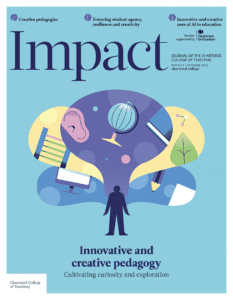
This issue of Impact explores creative and innovative pedagogical practices. Among other themes, it highlights the interplay between practitioners’ own agency and artistry, and students’ autonomy, agency and creative engagement. The risk that AI presents to human agency is also explored, with imaginative examples shared to mitigate concerns. The 19 high-quality professional commentaries, case studies and research articles presented in these pages show what is possible when school leaders, arts and other organisations, universities and teachers work creatively together.
In the first section, focused on creative pedagogies, Clare O’Sullivan reflects engagingly on how strong disciplinary expertise combined with creative practice can develop professional agency and artistry. She suggests that subject knowledge, creative pedagogy, teacher wellbeing and student outcomes may operate reciprocally. This is more than possible – likely, even – although much will depend on historical practices, experts’ autonomy and local and national discourses that may enable or constrain.
The next article in this section focuses on the Art of Learning programme, whereby teachers were positioned as co-creators working alongside artists. Authors Marie Othilie Hundevadt, Lamis Sabra and Szilvia Németh document how, over the 48-week intervention, practitioners tested creative learner-centred strategies in their UK, Norwegian and Hungarian classrooms.
In various ways, the potential for reciprocity between knowledge, creative pedagogy, teacher wellbeing and student outcomes is borne out in Kate Clark’s paper on the creation of a joyful curriculum. She emphasises the value of embedding creative practice to support pupils’ mental health and reminds us that children benefit in myriad ways from participating in the arts and collaborative creative activities. Kate contends that such engagement can strengthen ‘protective factors linked to wellbeing’, including, for example, increased confidence, reduced anxiety, caring relationships and a stronger sense of belonging.
A research paper in this section on creative pedagogies then details a fascinating Listening Playground project that made use of a web app and positioned 10–11-year-olds as researchers, investigating and collaborating agentically while using technology creatively and reflectively. Led by Maria Guerra Sappho, the team from the Universities of Huddersfield and Cambridge tracked how listening-led, sound-based technologies support creative, cross-curricular learning and, in particular, nurture children’s agency and autonomy.
The focus of Charlotte Bray and Caroline Barth’s paper is talk as a tool for nurturing students’ creative engagement. This case study on Speak Out! – a primary-phase two-year project exploring drama-based pedagogy – was a partnership project co-created by a trust, Derby Theatre and staff from six schools, supported by the Paul Hamlyn Foundation’s Teacher Development Fund. As the authors report, to enable effective continuing professional development and learning and to nurture creative pedagogy, the partners foregrounded the development of teachers’ conceptual understanding of drama and their playful exploration of its application in their classrooms. The project took time to build practitioners’ confidence through opportunities to participate physically, socially and emotionally in drama alongside their peers, before deploying this multimodal approach with children. Appropriately, the teachers’ creative participation was recognised as an essential precursor to using drama across the curriculum.
As extended professional development (PD) programmes, both Speak Out! and the Art of Learning align well with the renewed OfstedThe Office for Standards in Education, Children’s Services and Skills – a non-ministerial department responsible for inspecting and regulating services that care for children and young people, and services providing education and skills Inspection Framework’s (2025) emphasis on sustained evidence-informed PD to build teacher expertise. Furthermore, they both highlight professional experimentation, reflection and analysis as key tools that enable teachers to develop as artistically engaged pedagogues and curriculum developers.
Teacher creativity is a key characteristic of creative pedagogies, as noted in a systematic literature review (Cremin and Chappell, 2018) and a recent update (Chappell et al., 2026). The shaping influence of quality PD that nurtures educators’ agency, scaffolds risk-taking and supports a shift to more creative mindsets is seen in several papers in this issue. Yet, as Jen Ager and Dave Harvey show in their research paper on outdoor learning, pedagogical innovation only becomes feasible with the structural support of senior leaders and wider policy framing. Drawing on a mixed-methods design, including analysis of Ofsted Section 8 reports, school websites, an online survey of primary school leaders and focus groups, these authors reveal the necessity for outdoor learning to be recognised, valued and legitimised both locally and nationally. Despite the evidence that it can improve wellbeing and engagement and nurture a sense of belonging in pupils and staff (Oberle et al., 2019), they find that structural support is needed to enable creative practice to flourish in this space.
Encouraging autonomy and agency is the core focus of the papers in our second section, and is another characteristic persistently evidenced as core to creative practice in the research literature (Cremin and Chappell, 2018; Chappell et al., 2026). Several articles in this section indicate that intentionally agentic, student-centred and directed work is not only empowering, but can also enhance young people’s engagement and ownership of their learning.
Helen Riddle’s case study indicates that coaching-style questioning can be a useful mechanism for developing metacognitive awareness. Initially, to encourage reflection and agency, structured coaching questions were modelled through teacher–student interactions and prompts, and students were supported to engage in paired discussions. Over time, this shifted peer talk from seeking answers towards exploring strategies, and involved students in making their thinking processes explicit.
James Leigh considers the prominent role of pupil voice in Ofsted’s (2024) The Big Listen and suggests that this reflects a cultural shift, with autonomy and agency now more widely recognised as key to effective practice. He illuminates this with an argument about repositioning prefects as partners, which he posits could unlock student voice and agency and reduce traditionally conceived teaching and learning hierarchies.
Vicky Yiran Zhao’s case study considers students’ exploratory engagement in a maths enrichment club that afforded students agency and involved a considerable amount of collaboration and problem solving. The paper documents the innovative use of peer scaffoldingProgressively introducing students to new concepts to support their learning, with Year 11 students acting as co-facilitators alongside the teacher, supporting younger learners and modelling mathematical reasoning.
Karen Boardman et al. present a timely and relevant perspective on research that addresses significant pressures within Early Years SEND provision and details an innovative local response through the Early Years SEND Advocate training programme. The focus on advocacy, relational practice and compassionate partnerships makes for an inspiring and galvanising read.
Kelly Ashley and colleagues offer case studies of two secondary schools that successfully increased volitional reading in Key Stage 3 over the course of a year. Their paper shows that adolescents’ agency and autonomy as readers is nurtured when adults get to know them, notice what matters to them and create time and space for them to make their own text choices and control their own, often social, reading lives. The team highlight the value of a responsive autonomy-supportive pedagogy, arguing that autonomy is not an isolated theoretical construct in reading cultures, but a relational and dialogic process of belonging (Chappell et al., 2026).
In a not dissimilar manner, but with very young children, Debi Keyte-Hartland and Cathy Gunning found that when practitioners developed child-centred, highly responsive teaching for creativity, student autonomy played a pivotal role. Flourishing children showed independence and confidence, as well as risk-taking and resilience in their learning and development. Reminiscent of the earlier paper on outdoor learning, these researchers underscore the interdependence between practitioners’ and children’s agency. They argue that PD opportunities need to nurture educators’ agency both as creative individuals and as educators, since this can support the development of creative pedagogy.
The final article in this section analyses research gathered from boys with SEMH needs around their experiences of creativity, encouraging teachers to foster a creative approach to not only understanding student needs but also to shift the pedagogical focus to the creative process, which is often rooted in context and lived experience.
In the final section, supported by the Department for EducationThe ministerial department responsible for children’s services and education in England (DfEDepartment for Education - a ministerial department responsible for children’s services and education in England), our focus turns to innovative and creative uses of AI in education. The Chartered College of Teaching (CCT) has been working with Chiltern Learning Trust again this year to update the Safe and Effective Use of AI in Education support materials published on gov.uk. The examples of AI use and specific tools in this section support these materials but are for context only; they do not imply DfE or CCT endorsement or recommendation of any particular tool or approach. As the articles themselves often reflect, AI use needs to be carefully planned, and what is appropriate in one setting may not be elsewhere. Educators are advised to follow the DfE’s Generative AI In Education policy position and product safety standards, as well as aligning any AI use with the DfE’s latest Keeping Children Safe in Education guidance.
Micheal Fegan opens this section with a rich case study on developing a whole-school approach to ethical and purposeful use of AI. This commenced with sustained PD for all staff on how generative AI (GenAI) works and its limitations and pedagogic implications; staff were then encouraged to experiment. Somewhat parallel approaches were offered to students in their Key Stage 3 digital skills curriculum; they too were positioned advantageously as agentic participants rather than passive AI users.
The next paper affirms the need for senior leaders to take deliberately designed action to frame AI’s limits and purposes. Headteacher James Clements focuses much of his argument around the dependency risks involved and the potential loss of human agency if GenAI is treated as reliable and authoritative. Nonetheless, he posits that with human-centred leadership, it is possible for teachers to frame AI as an ‘exploratory partner’ and enable students to see it as a stimulus for critique, questioning and refinement. Fiona Aubrey Smith positions GenAI as a catalyst for agency, highlighting the inclusive advantages that can accrue when young people create artefacts (such as image, presentation, video or audio), noting that these include higher levels of self-reflection, critical editing of their work and increased effort. Fiona suggests these align with socially oriented and creative pedagogical approaches that centre agency, choice and voice alongside dialogue and iterative feedback. Not dissimilarly, the small-scale study undertaken by Lucy Caton, Zainab Patel and Chris Hesketh explores how AI-enhanced feedback might uphold human-focused pedagogies, including teacher–student relationships, in order to enable students with autism spectrum disorder (ASD) to develop agency and autonomy. The three examples they offer indicate AI’s potential value for students with ASD, specifically regarding predictability and experiencing relaxed, immediate feedback.
The next case study also indicates the contribution that AI can make when carefully and ethically deployed to support students’ understanding. In this, Stewart Lawson-Haskett, working in an international school, shares how he uses AI to strengthen access to learning for students with English as an additional language (EAL). Responding to the challenges that they encounter, he developed an AI support model comprised of three core approaches: dual-language AI chatbots to support subject-specific understanding of content, AI translators to enable interaction, and AI-generated media. As Stewart observes, while no technology can replace targeted EAL support or quality instruction, AI tools can – and, in this case, did – significantly enrich students’ learning experiences.
Reece Sohdi closes this fascinating summer issue with a clarion call to re-centre human creativity in this era of AI. As others have, he argues robustly that strong leadership and intentional pedagogical design are critical to avoid reducing learner agency and originality. However, he goes further, urging the profession to recognise creativity as foundational to education – as ‘a vital form of human agency’. In considering the pedagogical implications of this, Reece insists that teachers must remain focused on students’ learning, enabling exploration, idea generation and reflection as well as the development of AI literacy. He also argues that curious pedagogues who model their own creative engagement are key to such creative flourishing. I couldn’t agree more.
One of the privileges of curating this issue of Impact has been the opportunity to read these fascinating papers, and to reflect upon and enhance my own understanding of creative and innovative pedagogies in the process. Individually and collectively, they represent a rich and ultimately hopeful collection, a real professional testament to the perceptive and innovative work of the 35 professionals involved. I look forward to discussing the papers with others and recommend that you assert your own agency, debate the range of perspectives shared, ponder the potential for exploration and action in your own context, and develop your own confidence as a creative pedagogue.