

JEN AGER, UNIVERSITY OF CUMBRIA, UK
DR DAVE HARVEY, BANGOR UNIVERSITY, UK
Introduction and context
Outdoor learning (OL) offers well-documented benefits for motivation, wellbeing and holistic development (Waite et al., 2016). Although national initiatives such as the National Education Nature Park highlight growing commitment, OL remains inconsistently embedded in English schools. The National Curriculum review (DfEDepartment for Education - a ministerial department responsible for children’s services and education in England, 2025) has renewed attention on OL, with the government committing to a core enrichment offer including access to nature and outdoor experiences (UK Government, 2025). Implementation, however, often depends on individual enthusiasm rather than structural support (Oberle et al., 2021). This article presents findings from a small-scale scoping project exploring the roles of wider stakeholders and resources, particularly local authority (LA) advisers, OfstedThe Office for Standards in Education, Children’s Services and Skills – a non-ministerial department responsible for inspecting and regulating services that care for children and young people, and services providing education and skills and school websites, in shaping the status and practice of OL. It explores how pedagogical innovation becomes possible when OL is legitimised by policy, inspection frameworks and school leadership.
Literature review and rationale
While OL’s educational benefits are well established, barriers to implementation and questions of legitimacy persist. Studies identify practical challenges such as funding, limited time, senior leadership support and teacher confidence (Waite et al., 2016; Marchant et al., 2019). These reflect operational constraints but overlook deeper systemic influences that shape how far OL is regarded as a legitimate curricular approach. Social and cultural values, teacher motivations and parental support also play a role, as differing priorities shape expectations around OL (Parsons and Traunter, 2020; Harvey, 2022). Legitimisation – or how accepted and valued OL is within the curriculum – therefore becomes crucial. Without strong policy or institutional endorsement, schools may struggle to justify prioritising OL, creating permission-seeking cultures and risk aversion (Kemp and Pagden, 2019).
Prince and Diggory (2024) found that only 25 per cent of Ofsted reports mentioned OL, typically as enrichment rather than as core learning, while Scott’s (2025) analysis of 300 reports showed that subject-related OL appeared in fewer than five per cent of cases. This contrasts with data showing that 65 per cent of children now experience outdoor lessons at least weekly (Natural England, 2025), suggesting a disconnect between practice and reporting.
School websites represent another means of reinforcing OL’s value (Higgins et al., 2006; Campbell-Price, 2018). As expressions of school priorities, they can communicate ethos, build stakeholder trust (Karimi and Khawaja, 2025) and support school improvement planning (Ager, 2018). A further, under-researched influence concerns LA school improvement teams, whose advisory work is shaped by local contexts (Crawford et al., 2022). In the study area, where only 23 per cent of primary schools are academies, LA general advisers (GAs) remain a potentially significant force in legitimising OL. This study investigates how these factors interact, and how they might be harnessed to support teacher creativity and embed OL more systemically.
Methodology
OL is defined here as ‘planned and purposeful learning experiences that predominantly take place in the natural environment’ (IOL, 2025, p. 4). A mixed-methods design was adopted to generate rapid insights within a tight funding timeline. Data consisted of 265 Ofsted Section 8 reports and 276 school websites, analysed for references to OL under the definition above. Identified activity included outdoor pursuits, adventure-based residentials, curriculum-linked learning, Forest and Beach School, and outdoor experiences in school grounds or the surrounding environment.
A short online survey of primary school leaders in the study area (n = 8) included asking participants to rate the influence, investment and power of 13 stakeholder groups in OL implementation. In addition, three GAs from two LAs participated in a facilitated discussion exploring their roles and perceptions. Survey responses were analysed using descriptive statistics and weighted scores to map stakeholder influence. The focus group data was thematically analysed, with patterns identified in language, confidence and systemic barriers. Due to the short timescale associated with the project funding, the number of survey respondents was relatively low; however, participants were drawn from across a county and represented a range of settings. Uptake from GAs for the focus group was also limited – not through lack of interest, but due to availability constraints. These methodological limitations should be considered when interpreting the findings. Ethical approval was obtained from the relevant university, and participation was voluntary and anonymised.
Findings
Ofsted report analysis
Of 265 reports analysed:
- Forty per cent included aspects of OL under a broad theme of enrichment. Some statements support wider educational goals that Ofsted position as personal development – e.g. confidence and resilience building – but others frame OL as enjoyment and participation only. Several reports stated that pupils enjoyed or benefited from participating in adventurous outdoor activities but did not say how.
- Ten per cent made explicit reference to learning outdoors and either implied or stated a direct link to the curriculum. Subject connections were rarely mentioned directly, although specific environments and their associated learning (e.g. forests and beaches) featured in several reports.
- No reports made explicit reference to particular initiatives, such as Forest or Beach School.
The low number of curriculum-linked OL references may reflect limited recognition or limited practice, and inspection timing may also play a role, as OL that is not observed during the one/two-day visit is unlikely to be reported. Personal development support appears stronger, with 40 per cent of reports referencing OL and recognising a broad range of benefits. The Institute of Outdoor Learning’s guide to high-quality outdoor learning (IOL, 2025) identifies 10 outcomes across personal, social and skill development, showing that OL extends beyond curricular attainment. However, reports emphasising enjoyment risk reinforcing OL as ‘enrichment’ rather than core pedagogy.
School website analysis
Across 276 primary and special school websites, 47 per cent referenced some form of OL other than residentials, and 23 per cent (n = 64) specifically mentioned Forest School. OL was presented in varied ways, such as within the curriculum, as enrichment or as part of the school ethos. Of note is the seeming disparity between the number of schools referring to OL as an approach to teaching and learning and the number of schools where it is mentioned in that capacity in their Ofsted reports.
Focus group insights
Three GAs from two LA areas participated in a discussion session, providing valuable insight into how OL is understood, permitted and enacted across settings. The session explored current experiences, perceived barriers and opportunities for strengthening OL provision. Analysis highlighted that the legitimacy of OL as a pedagogical approach is influenced by multiple interrelated factors:
- The power of language: GAs noted that terminology significantly influences perception. Describing OL as ‘enrichment’ frames it as optional rather than core, reinforcing its marginal status.
- Confidence, autonomy and cultures of permission: Teachers’ confidence was identified as a central barrier, constrained by whole-school decisions, commercial schemes and compliance pressures. The need for explicit or implied permission was a recurring theme.
- Systemic legitimisation and external influence: OL is embedded when formally recognised in statutory frameworks, such as Early Years. In contrast, its absence from Ofsted frameworks creates a feedback loop: schools prioritise measurable curriculum elements, reinforcing risk-averse cultures and limiting pedagogical autonomy.
- Local authority support: GAs provide training, site visits and project-based support, but efforts are often needs-led and fragmented. Limited strategic collaboration within LAs suggests that OL is not consistently prioritised. Advisors emphasised that while personal enthusiasm drives innovation, passion alone cannot sustain practice without structural and institutional support.
Stakeholder influence
To visualise the relationship between stakeholder influence, formal power and investment in OL, we calculated three scores for each group: influence, power and investment.
- Influence was derived from survey responses to the question ‘How important are the following stakeholders in influencing the development of OL in your school?’ Respondents rated each stakeholder on a 1–5 scale, and weighted averages were calculated.
- Power reflects each stakeholder’s ability to shape curriculum decisions. High power (3) was assigned to Ofsted, the Department for EducationThe ministerial department responsible for children’s services and education in England, and MATMulti-academy trust - a group of schools working in collaboration, governed by a single set of members and directors CEOs and trustees; medium power (2) was assigned to governors, diocesan representatives and LAs; and low power (1) was assigned to teachers, children and parents, who exert influence but hold limited formal authority.
- Investment reflects the researchers’ judgement of each stakeholder’s level of commitment to OL, scored from 1 (low) to 4 (high).
By combining these three measures, the resulting infographic created by the researchers and shown in Figure 1 provides a visual comparison of where influence, formal power and investment align – or misalign – across stakeholders. This helps to highlight systemic challenges, such as groups with high influence but low power or limited investment, and highlights where targeted support may be needed in order to embed OL effectively.
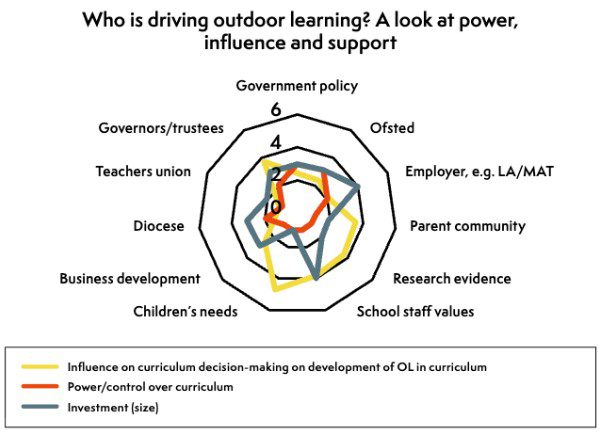
Figure 1: Drivers of outdoor learning
Discussion
OL offers a lens through which to examine how innovation in teaching can flourish when structures give teachers the support and permission to be creative. The challenge is not just resourcing individual initiatives, but embedding OL into schools’ cultural, strategic and evaluative fabric.
Ofsted’s influence extends beyond inspections, shaping school behaviour as leaders interpret perceived expectations (Bradbury et al., 2025). The frequently heard question ‘How do Ofsted regard outdoor learning?’ reflects this ambiguity and the challenges posed by an inspection framework that avoids explicit reference to specific pedagogies. OL links to curricular subjects in Ofsted reports are limited in scope, reflecting and reinforcing existing research, and there appears to be a considerable way to go before OL is recognised as an approach regularly worthy of specific mention. On the other hand, support for wider personal and social development outcomes is considerably more evident, although it is possible to question whether a full understanding of OL and its benefits underpin the comments.
The dearth of OL curricular references in Ofsted reports is at odds with how OL is portrayed on school websites, where the prominence of OL suggests that more OL activity occurs in schools than is reflected in the reports. Ofsted reports, focused on school performance, and school websites both provide opportunities for parents and other stakeholders to gain an understanding of what a school offers and values. For those schools that do promote their OL, when it features in headteachers’ welcomes or curriculum statements, it suggests stronger leadership endorsement.
Also related to school performance is the work of LA advisers, who interact with leaders and teaching staff to support school development and pupil outcomes. The research interviews illustrated that OL is valued but remains restricted by school-level decisions, external accountability pressures, commercially packaged curriculum schemes and the absence of systemic legitimisation. In school, the people who matter most in shaping day-to-day OL (children, teachers, parents) hold very little formal power, while those with the most structural authority (Ofsted, employers, the DfE) are not perceived to actively prioritise or invest in OL. Permission-seeking from teachers reflects research that successful change requires a clear vision and whole-school implementation plan (Aldridge and McLure, 2024). This mismatch creates a systemic challenge for embedding outdoor learning across schools.
Conclusion
Embedding OL improves wellbeing, belonging and curriculum engagement for all pupils, particularly those with limited access to nature. Teachers’ capacity to innovate and be creative is shaped not only by confidence or resources, but also by the structural signals that they receive from Ofsted, school leaders and wider policy discourse. Strengthening OL therefore requires coordinated action: clearer policy endorsement, leadership commitment and recognition of OL’s value as an approach to delivering the curriculum.
Why this matters for schools
- Leadership messaging matters: If OL appears in curriculum statements, websites and strategic plans it becomes easier for teachers to prioritise
- Inspection narratives shape practice: Schools can proactively highlight OL during Ofsted visits, ensuring that it is visible and valued
- Structuring support enables creativity: Clear systems, rather than individual enthusiasm, allow OL to flourish sustainably.











I really enjoyed this article and I completely agree that the value of outdoor learning should be more widely recognised. I love taking my students (even the older ones) outdoors whenever I can – they not only thoroughly enjoy getting out of the classroom but also become noticeably more engaged in their learning.
I encourage all members of my teaching team to incorporate outdoor learning as often as they can. However, I had not previously considered the importance of how prominently it features on our school website or how this can communicate and reinforce a school’s priorities. This article has given me something valuable to reflect on.