
CHARLOTTE BRAY, PRIMARY ITE, UNIVERSITY OF DERBY, UK
CAROLINE BARTH, DERBY THEATRE, UNIVERSITY OF DERBY, UK
This case study celebrates and articulates the transformative collaboration between six primary schools from an East Midlands trust and local theatre. The two-year project was externally funded by the Paul Hamlyn Foundation’s Teacher Development Fund, with the aim of exploring how drama pedagogy can add value for both pupils and schools in achieving aspirations.
The project focused on the development of teacher confidence, skills and understanding in supporting children’s oracy, vocabulary and communication skills in schools with an above-average EAL (English as an additional language) cohort, due to potential reluctance to contribute to classroom discourse (Oracy Education Commission, 2024). It explores how the collaboration of communities of practice (Wenger, 1998) has enabled both teachers and learners to progress and thrive in their different contexts, thanks to the use of drama as a creative pedagogy, building on research from McAtamney (2021).
Speak Out! was conceived as a process of co-creation between the trust, theatre and participating schools. Each school identified two lead teachers, selected and supported by the headteacher, to work in partnership with a drama practitioner over a two-year period. The approach was multifaceted and responsive to individual contexts, with the overarching aim of gradually transferring responsibility from practitioners to teachers.
The project focused on the integration of theoretical knowledge development and practical drama sessions to upskill school staff, alongside practical application and implementation of these skills within schools, supported by
a dedicated drama practitioner (Table 1).
Table 1: Example termly implementation
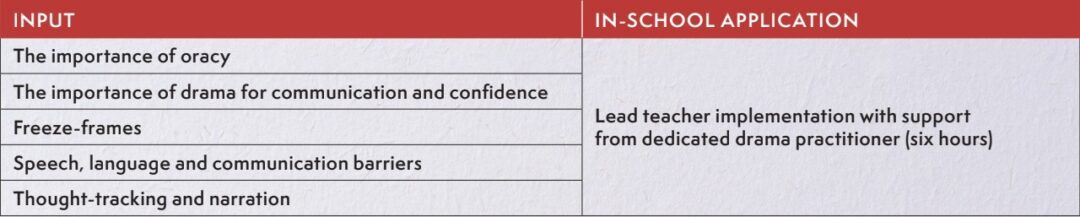
Year 1 focused on theoretical input with integrated evaluation, to upskill the teachers but also remain responsive to their learning journey. Year 2 expanded on this by allowing schools to lead how drama would be implemented within their individual curricula.
This input was supported by regular session evaluations and reflections from both teachers and artists, along with termly leader reflections, which allowed responsive adaptations where required.
The design drew on research indicating that successful continuing professional development and learning (CPDL) allows teachers to learn in varied and active ways, providing time to make sense of a new practice (EEF, 2021a).
Speak Out! was further enhanced during year 2 through the introduction of the Voice 21 Oracy Framework (2020), providing a solid structure on which to design the new drama-based approaches. Drama and oracy are inextricably linked, due to the importance of talk, listening and communication, as highlighted by the Oracy Education Commission report (2024), which mirrored the skills that the project wanted to nurture with students, through the development of teachers as creative practitioners.
The project design meant that it could be responsive both at a school level and at the overarching project level, with drama practitioners upskilling lead teachers, who then disseminated this learning to other teachers. In some schools, artists led whole-school CPDL, developing these skills for all staff.
Using professional drama practitioners to support creative exploration of research from Voice 21 (Watson, 2024) and The Sutton Trust (Levon et al., 2022) in order to collaboratively create drama-driven pedagogy across the curriculum, the project explored the ways in which the schools’ curriculum intent and implementation could be developed through collaborative partnership. The co-planning, delivery and reflection sessions between teachers and practitioners in school were integral to the process, combining the expertise of teachers and practitioners to create active, oracy-rich learning experiences.
Drama as a tool for teaching and learning was unfamiliar to most of the lead teachers at the start of their journey. The exercises invited the teachers to be experimental, engaging with each other socially, emotionally, physically and, of course, linguistically.
Building teachers’ confidence with the drama pedagogy was essential to enable them to adapt approaches to meet the needs of their individual classes and schools. This allowed for scaffolded implementation of the strategies – for example, using freeze-frames and simple narration to support basic sequencing in Key Stage 1 history, or layering thought-tracking and marking the moment to create role-plays using an art-based stimulus.
Equity and inclusionAn approach where a school aims to ensure that all children are educated together, with support for those who require it to access the full curriculum and contribute to and participate in all aspects of school life were central to Speak Out! Drama and oracy were employed as tools with which to challenge disadvantage and amplify marginalised voices. Activities such as bringing stories to life, embodying historical characters, using rhythm and playing games provided repeated opportunities for EAL learners to speak and build confidence.
Benefits for teachers
The project facilitated a shift from viewing drama as a supplementary activity to embedding it within core curriculum delivery. Teachers employed strategies such as conscience alley, hot-seating and structured debates to deepen conceptual understanding and promote dialogic learning. This transition reflected a broader pedagogical movement, from passive, didactic instruction towards experiential, student-centred approaches and active learning (Briggs and Collay, 2025). One teacher explicitly contrasted these methods with ‘death by PowerPoint’, underscoring the value of active engagement.
Teachers’ narratives illustrate a significant trajectory of professional development. Entering the project as novices, with limited exposure to drama-based pedagogy, one participant described the experience as ‘a crash course in active learning strategies’. Over time, teachers reported increased confidence in applying drama techniques, integrating them into lessons and advocating alternative assessment methods. This empowerment extended to challenging traditional practices, such as reliance on written evidence, by proposing multimodal approaches.
Benefits for learners
The metacognitive approaches empowered students to plan, monitor and evaluate their learning, fostering independence and self-regulation. The project identified gains in both confidence and communication skills – for example, students who previously exhibited reluctance to participate in discourse demonstrated notable gains in oral communication and collaborative problem-solving, aligning with key aspects of the framework.
Additionally, the development of subject-specific vocabulary and critical thinking was observed, using Education Endowment Foundation research on oral language interventions (EEF, 2021b) and collaborative learning (EEF, 2021c). Teaching students how to think about their thinking helps them to become more strategic learners, particularly beneficial for disadvantaged students who may lack the confidence to navigate academic challenges, aligning directly with the cognitive and linguistic strands.
When focusing on EAL and disadvantaged learners, findings highlighted the impact of exposure to high-quality language. Children with communication and interaction needs, or those who may have been constrained by ‘fear of getting it wrong’, made significant progress, with teachers citing specific individual examples where children who would rarely offer an answer in class were able to embody a character and imagine a range of scenarios or present in front of others, lighting up in a space that valued social and creative contributions alongside academic responses.
The project had a demonstrable impact on student engagement, particularly enhancing confidence, communication and collaborative skills, especially among those with additional needs or low baseline confidence. Examples provided highlighted students who previously exhibited reluctance to participate in classroom discussions as demonstrating notable gains in oral communication and collaborative problem-solving, mirroring the research from the Oracy Education Commission (2024). Oracy-based activities facilitated inclusive participation, enabling quieter students to meaningfully contribute. One student, identified as at risk of school refusal, displayed improved punctuality on days with scheduled drama sessions, suggesting a potential link between creative pedagogies and attendance. This was further supported by a comparison of class attendance within one school, where attendance for the class involved increased significantly during Speak Out!, highlighting links with theories of belonging (Allen et al., 2021).
Conclusion
Speak Out! also developed leadership skills within the lead teachers, regardless of their experience in the classroom. There was an increase in confidence and curriculum knowledge, prompted by the exploration of the alternative and active pedagogy. Leaders reflected on how their teachers had more confidence to approach subjects with a more practical stance.
All leaders across each of the six schools stated that drama and oracy are now part of the new school improvement plan, which focuses on embedding drama pedagogy into the curriculum. Leaders are committing to continuing CPDL for all staff, to support the development of drama across the curriculum and to build confidence following the impact of the Speak Out! project.
One of the teachers articulated their perspective of Speak Out!:
We have been taught how to use drama to develop children’s speaking and listening skills, and this has not just been successful; it’s been transformative. Through drama-based oracy activities – storytelling, role-play, structured debate – our children have found their voice. They are more confident, articulate and reflective. This impact has been particularly profound for our SEND learners, many of whom face barriers around communication, confidence or social interaction.
Primary teacher
This case study powerfully demonstrates the vital role of drama-based pedagogy in shaping modern education. It shows how drama can drive oracy development, enrich the curriculum in line with the Curriculum and Assessment Review (DfEDepartment for Education - a ministerial department responsible for children’s services and education in England, 2025) and strengthen learners’ sense of belonging, as reflected in the priorities set out by the Centre for Young Lives (2025). Drama is an essential tool for building confident, connected learners, particularly those who face the most disadvantage. Based on this rich learning, the theatre is now rolling out this practice to all schools in the area.










I really enjoyed reading this article. I completely agree with embedding drama across the curriculum rather than treating it as a distinct, additional subject. I regularly incorporate role-play, public speaking and drama-based activities into my lessons, and I see highly positive responses and benefits for my students.
The gradual introduction of the approach, with an emphasis on upskilling teachers, seems particularly important. Great to read about the reported increases in confidence and critical-thinking skills – the experience of the pupil at risk of school refusal was especially impressive. I would love to learn more about how these benefits were measured and evaluated across the six schools.