
DEBI KEYTE-HARTLAND, EARLY EDUCATION ASSOCIATE; ARTIST-EDUCATOR, UK
CATHY GUNNING, EARLY EDUCATION ASSOCIATE; EDUCATION COACH AND MENTOR, UK
Introduction
This article examines transformative learning at the midpoint of SPACE to Flourish – a four-year professional learning programme for Early Years educators in London, funded by the Mercers’ Company, delivered by Early Education (2024) and its associates, who author this article, and evaluated by the Centre of Research in Early Childhood. We present the project’s framework and aims with a thematic analysis of participants’ stories of impact, and conclude with practical implications from our interim findings.
The programme aims to boost educators’ confidence, self-efficacy and effectiveness in creative pedagogies and arts-based learning in order to enhance children’s creativity and flourishing. This is achieved using the arts as activators of learning and meaning-making across the Early Years Foundation Stage (EYFS) (Keyte-Hartland and Lowings, 2024). At the midpoint of SPACE to Flourish, 30 educators from 16 settings have begun to transform their practice and assess its effect on children’s creativity.
The SPACE to Flourish programme
SPACE stands for Supporting Pedagogies in the Arts and Creativities for Everyone. Our theory of change addresses school readiness through a flourishing framework based on Seligman’s (2011) wellbeing PERMA theory (positive emotion, engagement, relationships, meaning and accomplishment) to improve children’s personal, social and emotional development and their language and communication by fostering creativity and participation in the arts. Figure 1 highlights how SPACE weaves arts, creativity and time to think (Kline, 1999) to strengthen each PERMA pillar, expanding the conditions for children’s flourishing by activating and responding to children’s creativity.
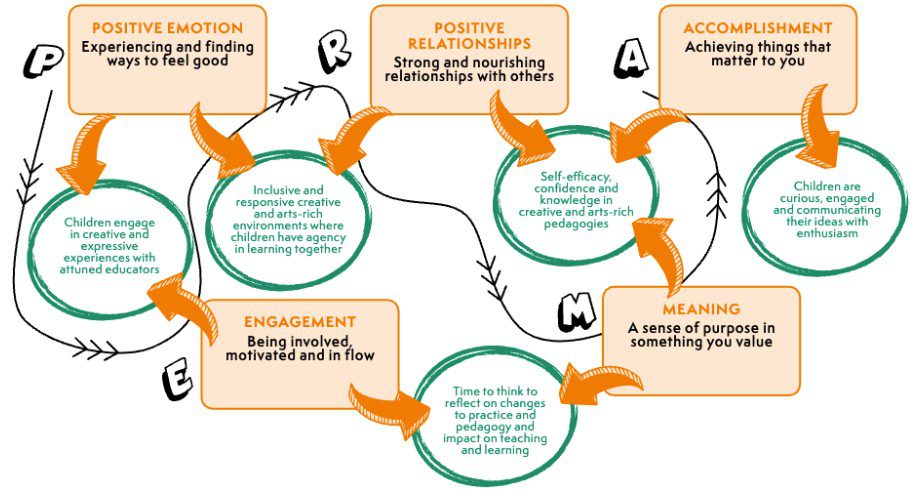
Figure 1: The interweave of Seligman’s PERMA model of flourishing (2011) with SPACE to Flourish outcomes
The programme was co-created by the authors and Early Education in response to research-based evidence for effective professional development (PD) (EEF, 2021; Mathers, 2020) to activate:
- reflective practice for adopting creative and arts-rich pedagogies across EYFS educational programmes
- attuned authentic coaching and mentoring to build teacher confidence and creative agency (CollectivED, 2024).
The two-year programme has three main components:
- Deepening pedagogy days: Enhance educator confidence and leadership in creative thinking and arts-based practice across EYFS, focusing on practical engagement, connecting theory to practice and reflecting on changes
- Group coach-mentoring: Build a collaborative, supportive community
- School or setting visits: Provide context-specific feedback, affirmation and support as changes are implemented.
Throughout the programme, educators, schools and settings benefit from:
- hands-on experience with creative pedagogies
- a reflective, motivated community in which to share innovative teaching practices
- tailored resources to expand their teaching toolkit
- coaching and mentoring, supporting effective, inclusive and creative learning.
The success of this programme is documented through educator stories of impact, created at the end of the programme. We define success as educators demonstrating strengthened confidence and intentional, inclusive and attuned pedagogical practices in arts and creativity, which enhance children’s communication, language, personal, social and emotional development, and overall wellbeing.
Data and evidence: Stories of impact and professional reflective journals
Participants created stories of impact, which made visible the sustained changes that they made to their practice and pedagogy and the impact that this had on children. Thematic analysis of these qualitative stories reveals how providing ‘time to think’ (Kline, 1999) enables educators to better understand creative processes and design sustainable environments that encourage creativity. Analysis also highlights parallels between educator and child agency. Three key themes emerged:
1. Growth of educators’ creative confidence and self-efficacy
Educators reported that exploring materials rich in creative potential, such as charcoal, light and paper, enabled them to gain experience and confidence in their own creativity, as well as an increased understanding of how children engaged creatively with media and materials. They reported that their ability to foster children’s creativity was increased through recognising indicators of children’s creative thinking.
I started this training saying to myself “I’m not an arty person and I find it hard to be creative” but I’ve definitely grown in confidence… It has been a very reflective process for me, and I have loved the amount of time dedicated to deep thinking… it is the training that has most influenced my practice since becoming a teacher.
Reception teacher, Greenwich
Educators’ creative teaching and confidence grew as they exchanged their successes and difficulties. These exchanges led to wider setting experimentation and transformation.
We actively involved staff in action research… [they] are more understanding of their role as co-researchers working in partnership with the children… Consequently, children now take ownership of their learning… understand that their ideas are valued and that there are endless possibilities in their creative expression.
Nursery teacher, Greenwich
Educators’ creative identities and beliefs significantly affected their interactions with children. Many reported that their limited creative confidence originated from their childhood educational experiences, and that such beliefs restricted children’s opportunities to develop crucial creative abilities and dispositions. Creating opportunities for collective experimentation with materials promoted in-depth reflection on both past experiences and current approaches, facilitating meaningful changes to practice with links made between theory and practice (Mathers, 2020).
2. Attuned teaching as an approach to recognising diverse creative thinking in children
Educators embraced an approach focused on observation to develop an understanding of children’s diversities in their curiosity, creativity and enquiry, which in turn supported inclusive and responsive ‘attuned teaching’ (Gunning and Lofthouse, 2022). Educators shared that they felt supported, revitalised and more confident in observing and planning for creativity.
Previously, I might have tried to manage [children’s] energy through structured activities. Now, I plan much more flexibly, using their natural enthusiasm as a starting point for creative exploration… This shift has made me more attuned to the different ways children express.
Reception teacher, Wandsworth
Educators who adopted attuned, inclusive and responsive teaching for creativity also developed more adaptable, child-centred environments for creative play, in which slow pedagogies (Clark, 2023) were developed – described by a teaching assistantAn adult that assists a teacher in the classroom in Greenwich as ‘adults [who] are attuned to the children and where learning is unrushed’.
At this midpoint in our research, we have found that educators are deepening their understanding of children’s creativity and how the arts activate learning across the EYFS to inform intentional yet responsive teaching through curriculum and environment design in four key ways:
- slowing the pace (Clarke, 2023) to provide attention, ease, appreciation and encouragement for children’s creative thinking (Kline, 1999)
- responding to children’s ideas and enquiries and engaging in conversations about them
- igniting creativity to occur everywhere, and not just in designated ‘creative areas’
- enabling time in which to curate and explore materials in the enabling environment, with time to experiment with possibilities.
3. The correlation between teacher and child agency as a necessary condition for creativity
Enabling children’s choices to be creative resulted in engaging, creative and inclusive experiences. Educators found that supporting children’s autonomy, curiosity and enquiry was more effective than enforcing set topics. Flourishing children showed independence, confidence, persistence, risk-taking and resilience in their learning and development.
What began as a focus on art quickly expanded into a broader, richer reimagining of how I view creativity and learning… My thinking about provision, resources and engagement has shifted from task-based planning to truly thoughtful, responsive environments where children are invited to explore, imagine and problem-solve. What I value most… is the sense of ownership the children now have in their learning. Creativity is no longer an activity we “do” at a certain time – it’s a mindset that shapes how we engage with the world.
Reception teacher, Greenwich
Children’s flourishing was also evident through their confidence in expression with different materials and art forms, particularly in inclusive environments that encouraged children’s agency.
In our setting, we now approach creativity as a rule-breaker, an idea-bearer, a problem-solver, a curiosity ignitor, a connection maker and a builder of self-esteem – where ideas, imagination, expression, feelings and independence intertwine and flourish… to discover their inner creativity at their own pace and on their own terms.
Setting manager, Wandsworth
During collaborative reflection on strategies to enhance children’s agency and adopt more responsive educational practices, educators discussed how external influences (directives from senior leadership, interventions and set programmes) limited their autonomy and agency to develop innovative teaching methods. Sustained progress depended on ongoing critical reflection and adaptable methodologies, supported by environments that fostered creative pedagogy and experimentation within a professional learning community. Enabling children’s agency was thus dependent on educators having agency.
Conclusions and implications
Our research indicates that fostering a ‘thinking environment’ (Kline, 1999), through collective experimentation, idea-sharing and practical engagement with materials, has increased educators’ creative confidence and self-efficacy, helping them to develop creative pedagogies and expand their understanding of children’s creativity.
Four main themes have implications for Early Years educators.
- Creativity beyond the table: Instead of limiting creativity to specific areas, educators who deepen their understanding help to integrate creative learning throughout all environments and subjects.
- The power of observation: Educators enhance teaching by observing and analysing creative play (which helps to avoid ineffective teaching) to foster children’s creativity and agency. These observations, when shared, contribute to team PD.
- Readiness for transition: Creative learning helps children to develop resilience, problem-solving, communication and collaboration skills, supporting smooth transitions into their next phase (Foster et al., 2025).
- Professional growth: Educators feel empowered and trusted when their thinking is heard, valued and appreciated. This is an essential factor for agency, confidence and sustainable impact. We are seeing how educator agency ignites thinking and supports an effective, attuned creative pedagogy.
The stories of impact reveal transformations in pedagogy, practice and knowledge in supporting children’s creativity, progress, school readiness, motivation, meaning-making and agency. We position creativity and the arts as vital for all learning across the EYFS and as necessary conditions for flourishing, in which learning is characterised as multi-modal, motivating, meaningful and lasting for all. As we move into our final year, we’ll welcome a new cohort, collaborate with previous groups to build a self-sustaining community of practice, and scale our model of professional learning to increase reach within the wider Early Years sector.