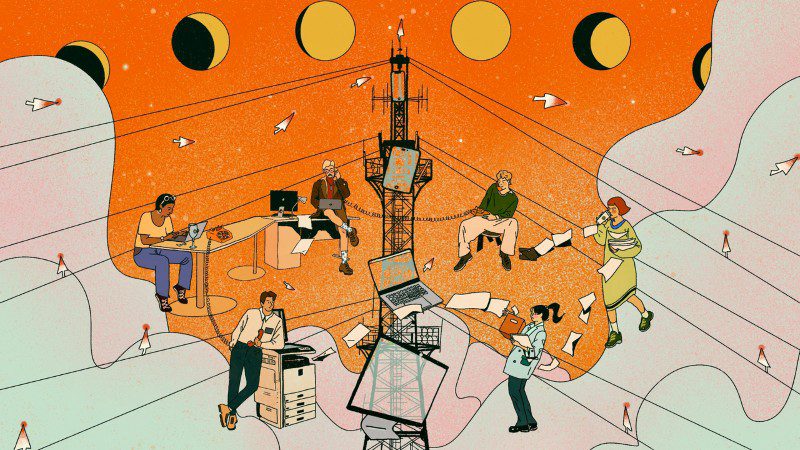
Featured image source: Yutong Liu & Digit / https://betterimagesofai.org / https://creativecommons.org/licenses/by/4.0/
DR FIONA AUBREY-SMITH, FOUNDER, ONE LIFE LEARNING, UK
Roughly 60 to 85 per cent of teachers are now using generative artificial intelligence (GenAI) tools for purposes associated with classroom practice (Latham and Montacute, 2025). These uses are widespread and varied, reflecting different exposure to AI awareness, products, training, policies and professional learning. Yet from an educational perspective, there are some significant and shared pedagogical undertones at play. For example, when teachers enable learners to use GenAI in classroom practice, it tends to be to create something (such as an AI-generated image, animation, poster, infographic, podcast and so on). This form of task design brings constructionist undertones – a belief that learning happens most effectively when the learner is consciously engaged in constructing a public-facing entity or artefact (Papert, 1980). Creative GenAI use by learners in classroom practice is therefore often operationalising a constructionist belief that making is a primary mode of knowing. Within this framing of pedagogy, knowledge is not static in the student’s mind but instead externalised and made viewable to an audience.
Historically, one of the most significant barriers to creative expression as a form of representing learning has been a lack of transferable skills involved in moving from concept to output. For example, if a student has a high level of cognitive understanding about a particular topic but has a low level of artistic or design skill, then their ability to communicate their understanding through visual form is limited – impacting their ability to demonstrate complex ideas. This problem reflects a common barrier where task design can exclude particular students or create false limitations on potential attainment (for example, students with dyslexia being required to evidence learning through handwritten work).
The introduction of GenAI in this landscape has operationalised a low-floor, high-ceiling approach – essentially guaranteeing a baseline level of aesthetic quality output. As a result, once very simple prompt skills have been acquired, a student can create a professional-looking artefact (such as image, presentation, video or audio) within seconds. When combined with accessibility tools for all, this alignment supports the Universal Design for Learning framework (CAST, 2018), by making multiple means of expression a scalable and practical reality rather than just a policy or aspirational ideal. Furthermore, studies have highlighted the significant impact on student motivation that this creates, whereby a student’s initial output validates their competence and encourages further effort, raising the stakes for precision and quality (Zhang and Ma, 2023).
Contemporary empirical research across primary, secondary and special school students using GenAI image creation suggests that where students have a meaningful choice about how they represent their learning, and the agency to do so in practice, they feel a greater sense of ownership and responsibility for quality outcomes (Aubrey-Smith, 2026). This appears to manifest through higher levels of targeted effort, sharper cognitive focus, disciplinary precision and synthesis of concepts within student work – indicators that are known to impact progression within subject disciplinary knowledge, as well as cross-disciplinary conceptual synthesis (Ryan and Deci, 2000). Ponomariovienė and Jakavonytė-Staškuvienė (2025) describe this shift as students moving beyond mere completion of tasks towards a state where they feel ownership of the intellectual property of their task – taking responsibility for extending it beyond classroom-oriented purposes.
Empirical research has found that that students’ increased effort (triggered by rewarding outputs achieved through use of GenAI) is typically seen through higher levels of self-reflection and self-regulation, an increase in critical editing and improvement cycles, and more constructive self and peer feedback, when compared to previous or traditional ways of working, such as paper-based equivalents (Aubrey-Smith, 2026). While these gains are generally only seen once students have secured the practical skills with which to use the GenAI tools fluently (generally after three to five lessons of application), the gains are notable. For example, on average, a secondary-aged student may review and edit a piece of work between zero and two times when paper-based, due to the cultural and societal value on presentation (for example, handwriting) and the inability to improve paper-based work without reducing presentation quality or duplicating the task. However, on average, a student using GenAI tools to produce a creative artefact will review and edit a piece of work four to seven times, because the format allows them to adapt (for example, reflection followed by refined prompting) and improve (such as digital editing of output) without reducing overall presentational quality (Aubrey-Smith, 2026).
Traditional paper-based tasks often suffer from a barrier of permanence (in other words, a student must rewrite substantial amounts if they are to improve anything more than minor edits), which discourages the iterative process necessary for deep learning. The use of GenAI can lower this barrier, facilitating what Henderson et al. (2019) describe as digitally mediated feedback loops. These loops allow for faster feedback, enabling students to engage in low-stakes experimentation and continuous improvement (Midgette et al., 2025). In addition, the immediate feedback seen through a visualised output (such as an updated GenAI image) enables students to decouple evaluation from social or emotional pressures, which can be a notable cause of classroom anxiety, allowing students to externalise their own work for the purposes of review and then think more objectively about its strengths and areas for improvement (Pintrich et al., 2000). This iterative process encourages students to act on self-review and peer/teacher feedback immediately, closing the loop between assessment and improvement and thus improving students’ feedback literacy (Simón-Grábalos et al., 2025; Schneider et al., 2022; Carless and Boud, 2018).
Within classroom contexts, the transition towards AI-enhanced creativity also marks an evolution in instructional materials. Empirical research covering primary, secondary and special school teachers indicates that where teachers are familiar with a portfolio of simple-to-use, creative digital tools, they mature beyond static, traditional teaching materials (such as text-based presentations or worksheets) towards multi-modal resources that forefront accessibility and inclusive practice for their students (Aubrey-Smith, 2026). The maturing of teaching and learning material from a single modality (for example, text-based) to multi-modal material (for example, using audio, image and video) aligns with findings from broader research literature and empirical studies that tell us that students have better cognitive understanding, better focus, better recall and better application when materials are multi-modal – largely due to the role of dual coding, reduction of extraneous load and use of multiple neurological connections (Mayer, 2021; Sadoski and Paivio, 2013).
Pedagogically, the use of GenAI by (and with) learners appears to offer some practical, scalable and personalised solutions to traditional classroom barriers – moving beyond handwriting as the dominant form of representing learning and the limitations that it creates – particularly for young people with text-oriented SEND (special educational needs and disabilities) and in a landscape where neat written presentation is sometimes valued over substantive content. However, it is important to see GenAI not as a solution applicable for all learners but as one tool in a contemporary learning toolkit. The most successful and impactful uses are likely to take place in classrooms where teachers facilitate learner choice and voice, purposeful peer dialogue and a culture of iterative feedback and editing. These forms of pedagogy align most with socially oriented pedagogical belief systems and reflect a majority of the education workforce. Yet, as reported in Impact in 2025, these forms of pedagogical belief are not uniform across the profession, with those describing themselves as AI enthusiasts often holding quite different beliefs about classroom practice (Aubrey-Smith, 2025). A potential friction therefore arises between the ‘ideal pedagogy’ of those leading AI conversations and that of the wider profession.
Our greatest takeaway must therefore be to return to the simplest (and yet most challenging) questions. In a landscape of generative artificial intelligence:
- What is the purpose of schooling?
- What forms of knowledge are valued?
- What does it mean to be an effective learner?
- What is the role of the teacher in all of the above?
The examples of AI use and specific tools in this article are for context only. They do not imply endorsement or recommendation of any particular tool or approach by the Department for EducationThe ministerial department responsible for children’s services and education in England or the Chartered College of Teaching and any views stated are those of the individual. Any use of AI also needs to be carefully planned, and what is appropriate in one setting may not be elsewhere. You should always follow the DfE’s Generative AI In Education policy position and product safety standards in addition to aligning any AI use with the DfE’s latest Keeping Children Safe in Education guidance. You can also find teacher and leader toolkits on gov.uk.