This article has been published as part of the Rethinking Curriculum project, kindly funded by The Helen Hamlyn Trust.
Debi Keyte-Hartland, Pedagogical Consultant, Artist-Educator and Researcher
Debi has worked with teachers and senior leaders at Woodlands Primary School and Nursery for over ten years, fostering reflective practice through pedagogical coaching.
Introduction
Woodlands Primary School and Nursery is in Madeley, Telford & Wrekin, and part of the Four Hills Education Trust. The school serves a diverse community shaped by socio-economic challenge, including higher-than-average levels of disadvantage, school-readiness gaps, and a significant proportion of pupils with special educational needs and disabilities (SEND).
At Woodlands, the curriculum is shaped by children’s needs, motivations and enquiries, alongside disciplinary knowledge. In the Early Years Foundation Stage (EYFS), this is realised through enquiry-based project work influenced by the Reggio Emilia approach (Project Zero and Reggio Children, 2001), in which the arts are understood as languages of learning. Children’s questions and ideas help shape the curriculum, while educators respond through observation, documentation and shared enquiry.
An enquiry-based pedagogical approach
Following an educational study visit to the pre-schools of Reggio Emilia, Italy, the then Head of Early Years at Woodlands (who became Headteacher, now retired) was struck by the depth of children’s enquiry and the central role of the arts in fostering creative thinking. Seeking to develop an enquiry-based, arts-rich curriculum in her own context, she approached me because of my expertise in the Reggio Emilia approach and my research into creative pedagogies. What began as monthly professional conversations evolved into sustained pedagogical coaching across the early years educator team. Together, we explored ways of rethinking teaching, learning, and curriculum through children’s expressive, creative, and conceptual enquiries, supporting educators to develop more reflective, responsive, and research-informed pedagogical practices.
Over time, Woodlands has embedded an enquiry-based approach to learning, positioning young children as active participants in playful, meaningful learning experiences. Children ask questions such as, ‘How do crabs hear underwater?’, identify and solve problems such as how to work together to build a strong bridge, and develop working theories about the world through their interests, enquiries and identities (Hedges, 2022). These ideas are developed through what Rinaldi (2021) describes as a pedagogy of listening—an intentional and responsive approach in which educators attend closely to what children say, do and represent, and use this to shape subsequent teaching. Observation, documentation and analysis therefore help educators assess learning, interpret children’s thinking, and decide what to offer next.
Pedagogical documentation—children’s artefacts, drawings, dialogue, photographs, and film clips—makes children’s thinking visible. At Woodlands, educators examine children’s drawings, talk, constructions, and use of clay and digital media as evidence of how knowledge and understanding are built and how ideas are revisited over time. In this way, materials and media are treated not only as resources for expression, but also as pedagogical mediators that support conceptual understanding, language and communication, as well as collaborative skills developed through shared enquiry.
Rationale
By centring a creative curriculum and an arts-rich, responsive pedagogy rooted in children’s enquiries, educators at Woodlands position children as imaginative and capable thinkers. The curriculum is co-constructed with children, foregrounding their agency and participation while expanding educators’ creative pedagogies (Chesworth, 2022). This means that children’s ideas, questions and expressive acts are treated not as peripheral to learning, but as significant contributions to curriculum-making and knowledge construction.
Participation in the arts and aesthetic experience can nurture individual growth and collective wellbeing, enabling children and adults to thrive as a community (Magsamen and Ross, 2023). Using expressive arts within enquiry-based learning can also support children’s flourishing—their positive emotions, engagement, relationships, meaning-making and accomplishment (Seligman, 2011) —by recognising their unique strengths and identities, particularly during periods of transition, such as the move to Key Stage 1 (Foster, Gunning and Keyte-Hartland, 2025). This approach values children’s imagination, originality and ideas over reproducing adult models or simply following instructions, creating the conditions in which children can think critically, represent ideas through multiple modes, and communicate with increasing ease and confidence.
Here, the arts are understood as languages that communicate through more than words. Through material and aesthetic experiences, children express ideas, feelings and theories with increasing complexity. These languages can build reciprocity, empathy and wellbeing within the learning community (Keyte-Hartland and Lowings, 2024) and help children construct knowledge about the world (Sellers, 2013). In this sense, the expressive arts are not separate from everyday learning; they mediate it by shaping how children explore, represent and make sense of their experiences.
Implementation
We began this work by dedicating staff meeting times and an INSET day to thinking about the processes and characteristics of enquiry we wanted to develop, alongside identifying the possible themes of enquiry that could emerge with the children. Rather than seeing professional development as a one-off event, we considered professional learning as rooted in ongoing reflection on practice. This reflected the approach of educators in Reggio Emilia who inspired senior leaders to develop creative enquiry practices that reframed professional learning as research into how children learn—and how educators teach—as the children themselves researched their world (Fawcett and Hay, 2008).
Educators began to develop their long-term enquiry work in pairs, committing to a self-selected area of interest, such as block play. Together, they developed extended enquiries with mixed Nursery and Reception groups. These enquiry-based projects explored themes including relationships between trees in the school grounds, the origins of dreams, and children’s graphicacy and its relationship to writing. Rather than viewing learning has occurring through isolated lessons or one-off activities linked to a topic, learning was understood as being shaped over time. This required making explicit connections to children’s experiences and enabling pedagogical processes such as revisiting children’s ideas to support the development of increasingly complex thinking over time; developing mastery through different modalities and materials, such as drawing and working with clay; and ensuring children’s agency in co-constructing the next steps with educators and in response to their ideas.
Educators brought pedagogical documentation to coaching sessions, where they collaboratively analysed the impact of their teaching, the curation of materials and the learning emerging from children’s experiences. Together, they reflected on children’s thinking, motivations and interests and, in response, co-designed next steps with colleagues and children. This approach exemplifies the dynamic and emergent nature of curriculum-making with children (Chesworth, 2022).
During the first year, practice shifted intentionally from pre-planned topics and adult-led activities towards a curriculum grounded in listening, participation, and children’s agency. Assessment became embedded within rigorous pedagogical enquiry, examining the relationship between educators’ intentions, enactment, and learning outcomes arising from children’s creative play, questions and material investigations.
Implementing this approach was not without challenges. Educators required protected time for sustained reflection and opportunities to develop critical dialogue about practice and pedagogy. This was enabled through pedagogical coaching that created the space and time to think deeply, question assumptions, and reflect critically.
A further challenge lay in balancing an emergent, lived curriculum, co-constructed with children, with the need to articulate and satisfy more prescribed curriculum requirements and accountability expectations, including those associated with OfstedThe Office for Standards in Education, Children’s Services and Skills – a non-ministerial department responsible for inspecting and regulating services that care for children and young people, and services providing education and skills. This tension reflects what Aoki (2011) describes as the relationship between the lived curriculum and the curriculum-as-planned. At Woodlands, this was supported through careful timetabling and ensuring that enquiries were playful, arts-rich and embedded across the early years provision and wider teaching team. The expressive arts became understood as central to how children learn, construct knowledge and develop understanding, rather than being positioned as an additional activity or an isolated area of provision.
Findings and impact
The enquiry-based, arts-rich approach to curriculum at Woodlands supports children’s learning in ways that are both cognitively challenging and relationally responsive. Grounded in careful observation, pedagogical analysis, and documentation of children’s experiences, this approach deepens educators’ understanding of how learning develops through relationships, dialogue, and shared enquiry. Teachers have observed that children are more engaged in learning and more willing and able to articulate, share, and develop their ideas with peers. Through sustained enquiry, children learn not only subject knowledge but also how to participate as confident, creative, and thoughtful members of a learning community.
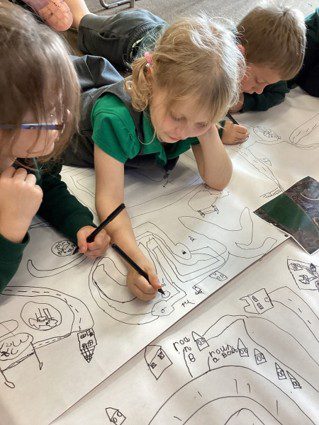
The expressive arts act as pedagogical mediators within this process by providing multiple modes through which children can represent, communicate, and develop their thinking. Arts-rich pedagogies, such as collaborative drawing and responding to questions through shared making with blocks or loose parts, enable children to think together, explore possibilities, and construct understanding collectively. The impact of this approach therefore extends beyond what children know to encompass how they learn to engage with others, negotiate ideas, and develop the relational capacities needed within a nursery and reception learning community.
Senior leaders identify clear educational value in this enquiry-based, arts-rich approach. Children make strong progress within the EYFS, while also developing the confidence, responsibility and creative thinking needed beyond achieving a ‘good level of development’. Leaders evaluate the quality of provision through curriculum review, moderation of children’s work and learning walks. These processes enable leaders to assess the quality of teaching and learning, identify where further professional learning, support and resources are needed, and use this evidence to inform priorities within the school development plan.
Recommendations for schools
For schools wishing to develop a similar approach, the implications are both pedagogical and organisational. It requires more than adding arts experiences to the already full timetable; it requires curriculum-making with children (Chesworth, 2022), effective professional learning and rigorous assessment that recognises children as capable co-constructors of meaning.
- Schools should invest in sustained professional learning that develops understanding of expressive arts pedagogy, pedagogical documentation and enquiry-based curriculum design. Effective professional development is ongoing, contextual and rooted in critical reflection on practice (Education Endowment Foundation, 2023).
- This professional development should be strengthened by coaching, mentoring and regular reflective dialogue. This helps educators move towards more attuned and responsive practices while maintaining curricular depth through intentional teaching.
- Schools should also reframe curriculum-making as a process undertaken with children and not just for them (Chesworth, 2022). This means planning learning contexts from children’s questions, theories and interests while connecting them to the educational programmes of the Early Years Foundation Stage statutory framework (Department for EducationThe ministerial department responsible for children’s services and education in England, 2025).
- A further recommendation is to strengthen pedagogical documentation. Documentation makes learning visible and helps educators interpret not only what children have learned but also how they learn. It enables shared reflection with colleagues, children, and families while contributing to the development of professional knowledge and understanding (Project Zero and Reggio Children, 2001).
- Schools should also protect environments, materials, and time for sustained exploration and enquiry. Open-ended resources and thoughtfully designed spaces that invite collaboration and experimentation support the characteristics of effective learning and the development of curiosity, persistence, and reciprocity (Department for Education, 2025).
- Finally, this work requires leadership that aligns policy, provision and pedagogical values. Leaders need to protect time, foster trust and enable professional autonomy for curriculum-making with children, while valuing creativity and the arts as central to educational purpose.
Conclusion
This case study demonstrates that when expressive arts are placed at the centre of pedagogy and curriculum-making, they can mediate knowledge, participation and wellbeing in ways that expand understandings of what counts as learning in the early years. The challenge for schools is not simply to add more arts experiences, but to create the conditions in which children’s enquiries and creative acts can shape ambitious and relational forms of education.
References
Aoki T (2011) Curriculum in a new key: The collected works of Ted T. Aoki. London: Routledge.
Chesworth L (2022) Curriculum making with young children. London: Froebel Trust.
Department for Education (2025) Early years foundation stage statutory framework: for group and school-based providers. London: Department for Education.
Education Endowment Foundation (2023) Guide to Effective Professional Development in the Early Years. London: Education Endowment Foundation.
Fawcett M & Hay P (2008) Researching children researching the world: 5x5x5=creativity. Trentham Books.
Foster H, Gunning C and Keyte-Hartland D (2025) ‘Expressive arts and design matters’, in Lee, K. and Veale, V. (eds.) School Readiness Matters: Embedded and Threaded Transitions. TACTYC.
Hedges H (2022) Children’s interests, inquiries and identities: Curriculum, pedagogy, learning and outcomes in the early years. London: Routledge.
Keyte-Hartland D and Lowings L (2024) ‘Learning to live well together: Art and ecological research with young children’, in Arts in Nature with Children and Young People. London: Routledge.
Magsamen S and Ross I (2023) Your Brain on Art: How the Arts Transform Us. New York: Random House.
Seligman M E P (2011) Flourish: A visionary new understanding of happiness and well-being. New York: Free Press.
Project Zero and Reggio Children (2001) Making Learning Visible: Children as Individual and Group Learners. Cambridge, MA: Project Zero, Harvard Graduate School of Education; Reggio Emilia: Reggio Children.
Rinaldi C (2021) In Dialogue with Reggio Emilia: Listening, Researching and Learning. 2nd edn. London: Routledge.
Sellers M (2013) Young Children Becoming Curriculum: Deleuze, Te Whāriki and Curricular Understandings. London: Routledge.