Samantha Jones, Advanced Practitioner: Teacher Development and Scholarship, Bedford College, discusses the considerations needed to achieve effective cooperative learning in further education.
I have been a lecturer in further education (FE) for 16 years – 12 of these as a business lecturer, and four in teacher education, where I teach on the PGCE PCET (Post-Compulsory Education and Training). I have recently completed an MSc in learning and teaching, researching continuous professional development (CPD) in FE colleges.
During my Masters-level studies, I began to develop a deeper understanding of cooperative learning, working as a group with team goals, a method that Slavin (1989) argues has a significant effect on student achievement and socialisation. Cooperative learning focuses on group interaction, as opposed to collaborative learning that emphasises the development of shared meaning. In order for cooperative learning to be successful, consideration needs to be given to the structure of the groups (Johnson and Johnson, 2009) and the ways in which students talk to each other (Mercer et al., 2004).
 I designed a group exploration activity where students focused on the discovery of a topic of their choosing via the internet. They used the classroom space to exchange ideas and resources, and were set a team goal of peer teaching their colleagues at the end of the activity. I modelled the types of high-level cognitive talk discussed by Gillies (2016): probing feelings, bringing in other students’ views and challenging ideas. By facilitating students working together to achieve shared goals, I aimed to explore and broaden their understanding of curriculum and pedagogies, in particular the ways in which group interaction can benefit learning.
The discussion at the end of the session focused on skills development. This is perhaps best explored through an example of a floristry lecturer who introduced the same cooperative learning techniques to her level three students as a consequence of this session. This decision, to replicate a pedagogy experienced in professional development, was motivated by the lecturer’s desire to develop a deeper understanding of fl oristry than she felt the curriculum presently offered her learners. After the initial introduction of the techniques into her classroom, she agreed with the consensus from the PGCE classrooms that the model appeared to organically develop research and cognitive skills (Webb and Mastergeorge, 2003).
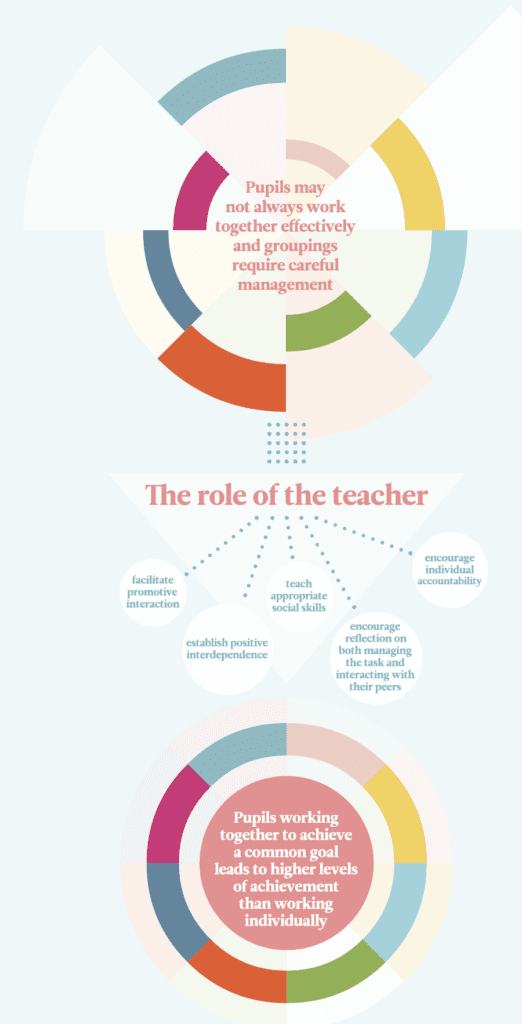
She observed, much as we’d predicted in the PGCE sessions, her students choosing to work within friendship groups, resulting in some students working hard in pairs, and some working in larger groups of up to six, allowing some students to ‘loaf’ (Johnson and Johnson, 1990). In our PGCE session, it was argued that opportunities allowing students to work through these team-working challenges were beneficial and that lecturers’ attempts to control group activities potentially took away these learning opportunities that are so transferable to the workplace. Gillies (2016), however, advocates teacher intervention. This was the approach of the floristry lecturer on the second occasion that she used the technique in her classroom; by challenging a ‘loafer’ to become a leader, the group began to work more cooperatively.
As a teacher educator, I felt that engaging in – rather than discussing – a pedagogical technique allowed teachers to make initial judgements on issues around the practicalities and applicability of cooperative learning to their practice. With a short exposure such as this, it is perhaps understandable that consideration of socialisation issues took precedence over attainment or higher-level cognitive talk. From the perspective of my own research
(Jones, 2016), I was interested to observe the replication of pedagogy into a lecturer’s classroom, something I have pointed to as an outcome of engaging in CPD. I feel that more consideration of the link between exposure to and judgements and replication of pedagogies within classrooms would be useful to the profession.
References
Gillies RM (2016) Cooperative learning: Review of research and practice. Australian Journal of Teacher Education 41(3): 39-54.
Johnson D and Johnson F (2009) Joining Together: Group Theory and Group Skills (10th ed.). Upper Saddle River, NJ: Pearson Education.
Johnson D and Johnson R (1990) Cooperative learning and achievement. In: Sharan S (ed) Cooperative Learning: Theory and Research. New York: Praeger, pp.23-37.
Jones S (2016) How and how far do identities and pedagogies affect the impact of CPD in a Further Education College? Masters thesis, University of Oxford, UK.
Mercer N, Dawes L, Wegerif R and Sams C (2004) Reasoning as a scientist: Ways of helping children to use language to learn science. British Educational Research Journal 30: 359-377.
Slavin R (1989) Cooperative learning and student achievement. In Slavin R (ed) School and Classroom Organization. New Jersey: Lawrence Erlbaum, pp.129-156.
Webb N and Mastergeorge A (2003) Promoting effective helping in peer-directed groups. International Journal of Educational Research 39: 73-97.