
TRUDI BARROW, ADVISOR, CLEAPSS, UK
‘Creative fidelity’ is a term that I use to describe the principle of retaining the intent of the author or designer when using artificial intelligence (AI) tools within creative processes. The word ‘fidelity’ is deliberately chosen. It implies faithfulness to something that already exists – for example, a design that has been considered or a decision that has been made. The aim is to preserve ownership of ideation with the human creator, using AI to visualise and develop ideas rather than to originate them.
AI can be used effectively in a range of ways in the design or creative classroom, and in some contexts it may be entirely appropriate to ask a tool to generate options, suggest refinements or propose alternatives. However, in lessons where the learning objective is to develop students’ capacity to problem-solve, design and use their own imagination, the role of AI must be more carefully defined. It can support learning through visualisation or rendering, but it should not assume the role of designer. That responsibility must remain with the learner.
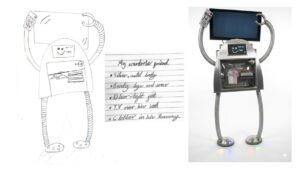
For example, when using an image-to-image generator to render sketches, the tool’s primary function should be to apply materials or visual treatments to the drawing provided. However, some systems alter the original design, ‘correcting’ elements that appear unconventional. A student intentionally designing an asymmetrical product may find the output adjusted towards symmetry. In such cases, the system is no longer rendering the idea but modifying it. The concern is not aesthetic quality but authorship. National guidance similarly warns against AI systems presenting themselves as agents or creators, emphasising that educational technologies should clearly communicate their function and avoid implying autonomous authority (DfE, 2026).
While similar functions have long been available through CAD rendering and image-editing software, contemporary AI systems enable ideas to be visualised with unprecedented speed and flexibility. This immediacy can be pedagogically powerful, but only when guided by attention to creative fidelity. Without it, there is a risk that learners’ intellectual property is displaced before it has been fully formed.
I propose that educators understand and apply the principle of creative fidelity when selecting and deploying AI tools, and that it is framed explicitly for students, enabling them to distinguish between outsourcing ideation and outsourcing communication through visualisation. Without such clarity, the creative process may be diminished, assessment validity called into question and learners steered towards increasingly standardised rather than original outcomes.
Literature review
Any discussion of creative fidelity must first establish what is meant by ‘creativity’ in an educational context, and why certain forms of it are particularly vulnerable to displacement by AI. Anna Craft’s distinction between ‘big C’ creativity, the exceptional and domain-changing contributions of recognised individuals, and ‘little c’ creativity, the everyday capacity for possibility thinking, remains foundational (Craft, 2001). Little c creativity is defined not by the significance of the outcome but by the learner’s active engagement in imagining alternatives and making purposeful choices. Kaufman and Beghetto (2009) refine this further through their Four C model, introducing ‘mini-c’, the personally meaningful interpretations and connections that emerge during the learning process itself. Mini-c matters here because it places creative value in the act of meaning-making, and not in the artefact produced. This is the precise point at which AI poses the greatest risk: when a tool generates or substantially determines an outcome, it is the learner’s subjective process of interpretation, selection and intent that is most likely to be lost. Creative fidelity names and aims to protect this threshold – to insist that, whatever role AI plays in a creative workflow, the learner’s thinking must remain the originating and organising force.
Protecting that space requires deliberate pedagogical structure. Vygotsky’s (1978) zone of proximal development describes the gap between what a learner can achieve independently and what they can accomplish with appropriate support. Rosenshine’s (2012) principles of instruction operationalise this through scaffolding – the gradual withdrawal of support as learners develop competence. Crucially, effective scaffolding does not do the thinking for the learner; it creates conditions in which thinking can develop. This distinction is directly relevant to AI in creative education. A tool that prompts reflection or supports visualisation of a learner’s own ideas operates within the zone of proximal development. A tool that generates outcomes on behalf of the learner bypasses it entirely. Creative fidelity draws on this logic: AI should function as a scaffold that is progressively reduced, and not as a substitute for independent creative thought. The question that follows is how a learner recognises whether they remain within that productive zone or whether the tool has begun to do the thinking for them.
The Education Endowment Foundation’s guidance on metacognition and self-regulated learning offers a direct response: effective learners are those who can plan, monitor and evaluate their own thinking (EEF, 2025). When learners are encouraged to reflect on their creative decisions, they are engaging in exactly this kind of metacognitive practice. This might involve asking whether an AI output still represents their intent, or articulating what they changed and why. Without such opportunities for reflection, AI tools risk short-circuiting not only the creative process but also the self-awareness that underpins independent learning. In creative subjects, where learners must continually make and justify design decisions, this capacity for reflective practice is especially important.
This concern is also reflected in recent national policy guidance, which states that AI tools used in educational settings should support learning processes rather than replace them, and should be designed to avoid undermining learners’ development or independent thinking (DfE, 2026). The principle of creative fidelity does not sit in opposition to current educational policy but instead provides a practical pedagogical framework through which those expectations can be enacted in classroom practice.
Recent empirical research reinforces this distinction. A systematic review of 111 studies found that AI can occupy different roles within creative learning, including facilitator, collaborator or artefact generator, each associated with different levels of learner autonomy (Urmeneta and Romero, 2025). When AI functions primarily as a support tool, learner ownership and self-direction remain comparatively high. As it shifts towards autonomous generation, the learner’s role in shaping the outcome may diminish. Creative fidelity provides a practical principle for keeping AI within the former role.
The capacity for independent decision-making and perceived ownership is increasingly recognised as central to effective human–AI collaboration. Guo et al. (2025) identify initiative, perceived ownership and cognitive effort as core components of productive creative performance. Although AI systems can increase efficiency and sometimes novelty, they may also contribute to convergence of ideas, reducing the diversity of creative thought rather than expanding it. This concern is supported by large-scale empirical evidence. Zhou and Lee (2024), analysing more than four million AI-generated artworks, found that overall productivity increased but average content novelty declined over time. The creative field expanded in volume while narrowing in variation. In a classroom context, this pattern raises a specific concern: when a cohort of learners uses the same generative tool with similar prompts, the range of outcomes may narrow rather than diversify, producing work that converges on the tool’s defaults rather than reflecting individual creative intent. This does not argue against the use of AI. Instead, it highlights the importance of maintaining human intent as the organising force within creative processes.
Taken together, these perspectives suggest that the key question is not whether AI should be used in creative education, but how it should be positioned. Framing this through a shared concept such as ‘creative fidelity’ provides educators with both a practical evaluative lens for selecting tools and a pedagogical language for discussing their use with learners. In doing so, it makes explicit the importance of preserving human intent as the organising force within creative work, while still recognising the legitimate role of AI in supporting visualisation, iteration and communication.
Examples
The following examples illustrate how creative fidelity operates in practice when AI tools are used to support rather than replace thinking.
Motivation and pride
In my experience, students who lack confidence in sketching or presenting ideas often respond positively when their rudimentary sketches are rendered through an AI tool that retains creative fidelity. Seeing their ideas realised can generate pride and a sense of ownership. This response aligns with research identifying perceived ownership as a core component of productive creative performance in human–AI collaboration (Guo et al., 2025).
In one design and technology lesson, students were eager to take rendered images home to share with their families because of the pride that they felt in their work. This outcome depended on selecting a tool that remained loyal to the original sketch. Without creative fidelity, the same level of ownership, pride and motivation would not have emerged.

Communication aid
Many design students experience friction in communicating their ideas. Some have stronger written communication skills than drawing skills, or vice versa. AI tools can support these learners by allowing them to combine written descriptions with drawn inputs to generate outputs that reflect their thinking more accurately. For this to work effectively, creative fidelity must be considered explicitly, particularly at the tool-selection stage.
As oracy gains prominence across curricula, this connection between visual rendering and verbal confidence becomes increasingly relevant. When students can present a rendered image that faithfully represents their intent, they are better positioned to explain and defend their design decisions with clarity.
Iteration, materiality and decision-making
AI tools can provide opportunity for visually experimenting with materials, finishes and contexts. Allowing students to visualise a design in multiple materials or environments can support decision-making within iterative processes. However, if creative fidelity is not preserved, the design may be altered and ownership of intent reduced.

Tangible takeaways
Creative fidelity is not simply a theoretical concept; it is a practical lens that educators can apply immediately when integrating AI tools into creative subjects. Below are actionable steps for embedding creative fidelity into classroom practice.
Audit your AI tools for fidelity before use
Before introducing any image-to-image or generative AI tool into a lesson, test it with a range of deliberately unconventional inputs: asymmetrical forms, unusual proportions and non-standard designs. If the tool ‘corrects’ these features towards a norm, then it does not meet the threshold for creative fidelity and should be reconsidered or used with explicit caveats to students about its limitations.
Teach creative fidelity as a named concept
Make creative fidelity part of the shared vocabulary in your classroom. When students understand the distinction between outsourcing communication (using AI to visualise their own ideas) and outsourcing ideation (letting AI generate the ideas), they are better equipped to use these tools with intent and independence. Frame it as a question that students can ask themselves: ‘Does this output still represent my design intent?’ Research indicates that learner autonomy decreases as AI shifts from support tool to autonomous creator (Urmeneta and Romero, 2025). Making this judgement explicit helps students to maintain authorship and metacognitive awareness.
Establish design intent before introducing AI tools
Evidence suggests that pre-thinking improves prompt quality and creative outcomes because AI outputs depend strongly on human input framing (Guo et al., 2025). The more confident a student is in their intent, brief and idea before using AI, the more likely they are to retain ownership of it and recognise when the AI tool is offering new ideas and moving the design in a different direction.
Treat prompts as evidence of thinking
Encourage students to save prompts as part of design documentation. Prompt construction reflects cognitive strategies and creative reasoning and can therefore be used for assessment (Guo et al., 2025). When considering use of AI in non-examination assessments (NEAs) make sure that you check with your awarding body as to their specific policy, and remind students to always cite sources including AI use. Require annotation explaining what decisions were made by the student and what was generated by AI. This supports transparency, attribution and reflective practice.
Compare outputs critically
Have students analyse differences between AI-generated results and their original concepts. This strengthens metacognition, reinforces ownership and positions AI as a tool rather than an authority.
Teach tool selection as a design decision
Choosing an AI system should be framed as part of the design process. Students should evaluate tools based on whether they maintain fidelity to intent, and not simply on speed or polish.
The examples of AI use and specific tools in this article are for context only. They do not imply endorsement or recommendation of any particular tool or approach by the Department for Education or the Chartered College of Teaching and any views stated are those of the individual. Any use of AI also needs to be carefully planned, and what is appropriate in one setting may not be elsewhere. You should always follow the DfE’s Generative AI In Education policy position and product safety standards in addition to aligning any AI use with the DfE’s latest Keeping Children Safe in Education guidance. You can also find teacher and leader toolkits on gov.uk.