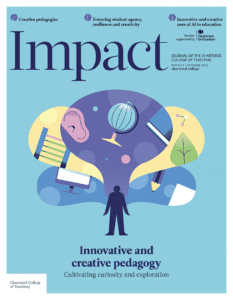
Featured image source: Nidia Dias & Google DeepMind / https://betterimagesofai.org / https://creativecommons.org/licenses/by/4.0/
MARVIN STAROMINSKI-UEHARA, ADJUNCT ASSISTANT PROFESSOR, TEMPLE UNIVERSITY, JAPAN
This article examines how generative artificial intelligence (GAI) supports the transition from subject-based teaching to integrated curriculum (IC) models in primary and secondary education. A systematic literature review of 22 empirical studies published between 2022 and 2025 was undertaken in order to evaluate the relationship between GAI, interdisciplinary learning and the development of 21st-century skills. Evidence indicates that GAI strengthens cross-disciplinary connections, enhances cognitive and behavioural outcomes, and improves critical thinking, creativity, collaboration and communication. Drawing on these findings, the article proposes the Originality and Creativity Index (OCi), a collective assessment framework designed to measure educational impact through interdisciplinary, community-focused student portfolios. Implementation challenges and future research directions are also discussed.
Highlights
- GAI significantly amplifies the effectiveness of integrated curricula in developing 21st-century skills in primary and secondary students
- Traditional standardised assessments are structurally inadequate for capturing the learning outcomes that GAI-enhanced IC models produce
- The Originality and Creativity Index (OCi) offers a practical, complementary portfolio-based framework for assessing collective creativity, real-world impact and community contribution.
Introduction
Generative artificial intelligence (GAI) has become a catalyst for change in education by altering how students learn, how teachers design learning experiences and how schools structure teaching practices (Alier et al., 2024; Mao et al., 2024). These technologies accelerate access to information, allow rapid synthesis of knowledge and offer personalised learning environments (Dobrin, 2024). Such capabilities are particularly suited to supporting integrated curricula, which connect disciplinary knowledge through coherent themes or real-world problems (Hu et al., 2025; Kim, 2025). Through real-time assistance in planning and instruction, GAI strengthens interdisciplinary coherence and provides teachers with resources that support integrated pedagogies (Zhou et al., 2022; McGee, 2023).
Despite increased interest in cross-disciplinary approaches, subject-based curricula remain dominant in global education systems (Mitra, 2013). Their continued prevalence is linked to long-standing confidence in discipline-specific assessments, including memory-based examinations and standardised tests, which have historically been used to predict academic achievement and future success (Artelt et al., 2001; Berkowitz and Stern, 2018). However, such approaches often prioritise information recall over creativity, inquiry and real-world application (Meylani, 2024). Moreover, they inadequately reflect the broader competencies required in an artificial intelligence era, during which transferable skills, adaptability and collaborative problem-solving are increasingly essential (Benvenuti et al., 2023; Díaz et al., 2022).
This study addresses two research questions:
- What relationship exists between GAI and the transition from subject-based to integrated curricular models in primary and secondary education?
- How does this transition affect student learning outcomes and assessment practices?
Three hypotheses guided the review:
- GAI improves cross-disciplinary synthesis
- IC strengthens creativity, critical thinking and real-world competence
- AI-enhanced IC environments increase engagement, collaboration and societal contribution, while maintaining academic rigour.
To support this transition, the article proposes the Originality and Creativity Index, a framework that values collaborative, impactful work over individualised test performance.
Method
A systematic literature review was conducted in June 2025 using Google Scholar. Search terms combined variations of ‘generative artificial intelligence’, ‘integrated curriculum’, ‘21st-century skills’ and ‘primary’ or ‘secondary education’. Inclusion criteria required empirical evidence addressing GAI, curriculum integration or creative and critical skill development in school-aged learners. Higher education studies, purely technical papers and theoretical articles without implications for practice were excluded. The review followed PRISMA procedures. From 1,720 initial records, 1,352 peer-reviewed studies and dissertations remained after screening for academic quality. Title and abstract review yielded 335 relevant papers, of which 22 met all criteria after full-text evaluation. This review acknowledges that this relatively small sample limits both the generalisability of its findings and the ability to establish definitive causal relationships; however, the consistency of positive outcomes across these varied designs points to a robust and convergent pattern of evidence supporting GAI-enhanced integrated curricula. These final studies represented diverse methodologies, including case studies, quasi-experiments, bibliometric analyses, interviews and surveys.
Results
GAI and the transition to integrated curriculum
Evidence across the reviewed studies demonstrates that GAI contributes directly to interdisciplinary teaching. A meta-analysis found a moderate-to-strong overall effect on student learning outcomes (g = 0.572), with particularly strong gains in computational thinking (g = 1.104) and critical thinking (g = 0.632) (Hu et al., 2025). GAI tools enabled cross-disciplinary inquiry by providing instant feedback, pattern recognition and resource generation. Several studies highlighted increased student capability to engage with interdisciplinary AI applications. For example, machine learning and natural language-processing tools functioned as ‘objects to think with’, supporting conceptual understanding across science, technology and language learning (Lin et al., 2025; Ibrahim Brian, 2025). Gamified problem-based environments using large language models improved critical thinking in programming and STEM (science, technology, engineering and mathematics) education (Kassenkhan et al., 2025).
Impact on learning outcomes and assessment
The reviewed evidence consistently shows that GAI-enhanced IC improves student performance on multiple dimensions. Large-scale implementation involving 25,432 students documented substantial productivity and creativity, including 75,422 generated ideas and 196 patent applications (Zhao and Gao, 2023). AI literacy programmes recorded statistically significant improvements in understanding, application, ethics and creativity, with large effect sizes (Ng et al., 2024). GAI integration also allowed students to produce scientific outputs with higher accuracy, such as virtual pH meters outperforming human interpretation by a factor of over five (Jiang et al., 2023). Students demonstrated transfer of AI thinking in mathematics and problem-solving, applying models to novel contexts (Kim and Chang, 2024). In middle school scientific inquiry, nearly half of AI-supported conversations focused on experimental variables, with many involving multi-turn dialogues that refined students’ designs (Min et al., 2025).
Hypothesis testing
Hypothesis 1
GAI enhances cross-disciplinary thinking, with behavioural outcomes showing particularly strong effects in self-regulation and literacy. When mediated by teaching strategy, integrated approaches produced significant improvements across learning experience, competencies and interaction (Suputra et al., 2024). These findings are further supported by evidence from seven national curricula, which demonstrated successful interdisciplinary AI integration (Zhou et al., 2022).
Hypothesis 2
IC consistently leads to superior learning outcomes across multiple domains. Interdisciplinary STEM approaches have been shown to improve critical thinking and knowledge retention (Ntimane et al., 2025), while machine learning-enhanced science curricula produced large gains in conceptual understanding (Rabinowitz et al., 2025). Similarly, integrated biology-AI instruction correlated strongly with improvements in both scientific and AI literacy (Zha et al., 2025). At the curricular level, International Baccalaureate interdisciplinary units further strengthened metacognitive skills and holistic assessment practices (Termaat, 2024).
Hypothesis 3
AI-enhanced IC strengthens both engagement and broader societal impact. In the context of environmental education, AI support was shown to improve critical thinking, performance expectancy, social influence and knowledge application (Du et al., 2025). Beyond the classroom, open schooling projects underpinned by AI competencies boosted transversal skills across three countries (Okada et al., 2025). Complementing these findings, AI-driven sustainability initiatives increased student confidence, motivation and collaborative learning (Ng et al., 2024).
Discussion
GAI, STEM integration and skills development
The dominance of STEM-related findings suggests a natural alignment between scientific inquiry and AI-enhanced integrated learning. Evidence shows successful applications in biology, chemistry, physics and agricultural sciences (Zha et al., 2025; Jiang et al., 2023; Min et al., 2025; Ntimane et al., 2025). These contexts provide data-rich environments that match GAI’s pattern-recognition capabilities. The most compelling evidence of creative capacity is reflected in large-scale innovation outputs – thousands of ideas, hundreds of awards and documented real-world implementations (Zhao and Gao, 2023). Such outcomes demonstrate the inadequacy of traditional assessments in capturing authentic learning (Simpson, 2024).
The Originality and Creativity Index
The OCi framework gives classroom teachers a structured way in which to assess four dimensions of student performance: critical and analytical skills, communication, collaboration, and community originality impact. Rather than measuring individual recall, it captures what students can collectively design, build and contribute to their communities. Teachers can apply it alongside existing subject assessments without displacing them, making it adaptable across a range of school contexts, including those following the International Baccalaureate (Termaat, 2024). Student portfolios offer a natural vehicle for this evidence, documenting the iterative and collaborative learning that GAI supports (Lin et al., 2025). Local sustainability challenges, cultural heritage projects and community planning initiatives all make meaningful, teacher-manageable assessment tasks.
Implementation challenges
For classroom teachers, the most immediate barriers are workload, limited access to technology and uncertainty about how to integrate GAI effectively into daily practice. Encouragingly, evidence suggests that success depends less on technical expertise and more on sound pedagogical decision-making (Comerford, 2025). Schools and policymakers should therefore prioritise sustained professional development and protected collaborative planning time (McGee, 2023; Bramley et al., 2025). Standardised rubrics, peer calibration sessions and AI-assisted evaluation tools can help teachers to assess interdisciplinary work with confidence and consistency (Termaat, 2024; Irwanto, 2025). Tracking student growth across a unit or term, rather than at a single point, better reflects the cumulative nature of integrated learning (Du et al., 2025; Kim, 2025). Teachers should also remain attentive to how unequal access to digital resources may limit some students’ participation in community-facing projects (Wakeling, 2024).
Conclusion
For classroom teachers, evidence emerging from this literature review carries a clear and actionable message: GAI, when embedded within integrated curricula, can meaningfully strengthen students’ creativity, critical thinking, collaboration and communication. The 22 reviewed studies show that these gains are consistent across subjects, year groups and national contexts, making this a finding upon which teachers across settings can act. The briefly proposed OCi framework offers a practical tool for capturing what traditional tests cannot, fostering collective originality and real-world contribution. Challenges related to teacher preparedness, resource inequities and assessment consistency are real but addressable through institutional support. Teachers who begin with small, GAI-supported interdisciplinary projects are well positioned to cultivate the adaptable, innovative learners that an AI-transformed world increasingly demands.
The examples of AI use and specific tools in this article are for context only. They do not imply endorsement or recommendation of any particular tool or approach by the Department for Education or the Chartered College of Teaching and any views stated are those of the individual. Any use of AI also needs to be carefully planned, and what is appropriate in one setting may not be elsewhere. You should always follow the DfE’s Generative AI In Education policy position and product safety standards in addition to aligning any AI use with the DfE’s latest Keeping Children Safe in Education guidance. You can also find teacher and leader toolkits on gov.uk.