
An Inside Look at Impact Issue 26: Equity in Teacher Education and Development

Join us for a look inside the latest issue of our award-winning Impact journal (Issue 26: Spring 2026). This issue focuses on equity in teacher education and development. Articles explore the importance of making training and recruitment practices as fair and equitable as possible; developing teacher agency, wellbeing and belonging; building successful approaches to mentoring […]
How to effectively tackle bullying

Bullying can have a devastating impact on children and their education. For those targeted, it can lead to fear, isolation, declining mental health, loss of confidence and disrupted learning. An upcoming OECD paper, Bullying in education: prevalence, impact and responses across countries, will reveal which groups are most vulnerable to bullying and will highlight where the problem is […]
Teaching quality and how to optimise it
Teachers are the most important factor for student learning and development that we as schools can influence. So, there is good reason to consider how we can optimise the quality and impact of teachers. Based on scientific research, this session will examine what we know about teaching quality (what is it, what impact do teachers […]
Fellow Sip and Share – White Paper Reactions and Response

As part of your Fellowship at the Chartered College of Teaching, we are seeking to engage further with you, and provide the opportunity to network and share your experiences with other Fellows. The Fellow Sip and Share series will offer a brief opportunity to speak to other Fellows about pressing topics that you may be […]
Insights to Inclusion: Evidence‑based practice to raise educational outcomes for students with SEND: from targeted to universal approaches

In this webinar, Professor Jo Van Herwegen will explore the current research landscape and evidence on the use of targeted interventions for students with SEND, highlighting what we already know, and where the gaps in our evidence base remain. Drawing on insights from the MetaSENse database, Jo will unpack the practical challenges to implementation that […]
Learning and Reasoning Group Seminar – Difficult Concepts: Hard Words to Learn

Centre for Education Neuroscience warmly invite you to join them for their Learning and Reasoning Group seminar taking place on Wednesday, 11th February, from 5 pm – 6 pm (GMT time). Prof. Susan Carey will be presenting on difficult concepts, hard words to learn. Abstract: Beyond doubt, in my view, four decades of research has established […]
Mobile eye-tracking as a window on inequity in children’s language development opportunities
This talk presents both empirical findings and methodological insights from a Belgian interuniversity research project TACOS, which investigates preschool teachers’ language-supporting competencies through a multimethod approach. This seminar discusses the use of mobile eye-tracking (MET) to examine the question: Which children are being overlooked, and with what consequences for their language development opportunities? In a […]
Engaging Effectively with Evidence: Huish Centre and Camtree – ‘Putting students and teachers at the heart of professional development’

Q: What happens when you empower professionals to critically engage with research in their context and support colleagues to become researchers themselves? A: Professionals become the beating heart of research into practice. This webinar will share with colleagues the power of putting professionals at the helm of research application and development and the crucial role […]
Why should we care? Empathy in education policy, practice and assessment
Empathy plays a central role in how children interact with others, build relationships and contribute to supportive and inclusive schools. It matters for cohesive, peaceful societies. Yet while many recognise its importance, education systems still struggle to define empathy, teach it and create policies and assessments to support and monitor its development. In this webinar, […]
Gender differences in mathematics in 1st grade: what are the causes? How to reduce them?
This week at the CEN seminar, Dr Franck Ramus will be presenting a talk entitled “Gender differences in mathematics in 1st grade: what are the causes? How to reduce them?” Recent surveys indicate that gender differences in mathematics—favoring boys—emerge as early as first grade, in France as in the United States. This presentation will report on several studies conducted […]
Sarah Johnson – Storytelling and SEMH
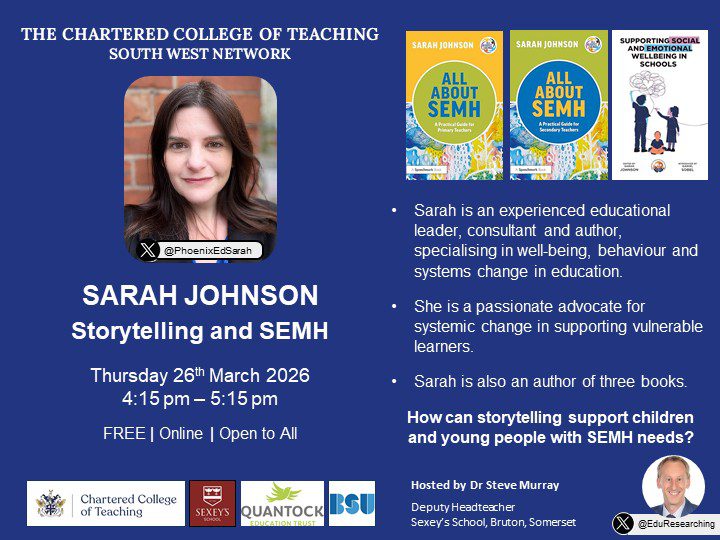
How can storytelling support children and young people with SEMH needs? Storytelling is more than a literacy tool – it is a powerful relational and emotional bridge. In this webinar, Sarah Johnson explores how storytelling can support children and young people with social, emotional and mental health (SEMH) needs by creating safety, connection and meaning. […]
Next Generation Assessment: Making Meaningful Change in Educational Assessment
Meaningful change in educational assessment starts with two things: big ideas about what is needed and the small steps that teachers and leaders can take to bring about this meaningful change. In this webinar, Professor Bill Lucas will be in conversation with Dr Laura Kerslake. They will discuss possibilities for new or alternative forms of […]
School Avoidance and Anxiety: A School Perspective
Dr Rebecca Torrance Jenkins, former Head of Science and advisor in neuroscience informed pedagogy and school design, will explore the underlying reasons why some children struggle to attend school. Emotionally Based School Avoidance (EBSA) refers to situations in which emotional, psychological or nervous system stress leads a child to avoid or be unable to sustain […]
Missing Mothers: retaining and supporting valued colleagues in the workforce
For parent-educators, school and organisational leaders. Over their two morning events, The MTPT Project will empower you to make practical changes to build more family-friendly working environments in your settings. Speakers include keynotes from MTPT Founder, Emma Sheppard; Being Luminary’s Angie Brown, and the Fatherhood Institute’s Jeremy Davis. Choose from twelve sessions and three panel […]
PARTNERSHIPS: What governors need to know and ought to ask

Cross-sector collaborations have become part of the life of all good schools. But do governors know how they operate? Who is involved? How the students and staff – and the school as a whole – is benefiting? And what about the budget in these constrained times and the “return on investment” – are the partnerships […]
The Learnus Annual Lecture – Brainstorms: the neuroscience of learning, tantrums and the modern world

Brainstorms: the neuroscience of learning, tantrums and the modern world Professor Sam Wass, Developmental Cognitive Neuroscientist, University of East London, Director of the Institute for the Science of Early Years and Youth (ISEY) at UEL. This talk explores how childhood is changing. During early development, young brains learn best from slow, predictable environments. But the […]
Missing Mothers: retaining and supporting valued colleagues in the workforce
For parent-educators, school and organisational leaders. Over their two morning events, The MTPT Project will empower you to make practical changes to build more family-friendly working environments in your settings. Speakers include keynotes from MTPT Founder, Emma Sheppard; Being Luminary’s Angie Brown, and the Fatherhood Institute’s Jeremy Davis. Choose from twelve sessions and three panel […]
Stepping Up with Confidence: Interview Strategies for Career Progression

Interviews in education can be unpredictable — from data tasks to panel rounds to “teach a lesson” observations — but successful candidates understand how to prepare with purpose. In this webinar, experienced leaders and recruiters will demystify the interview process and share strategies that have helped candidates secure roles at every stage, from ECT to […]
Telling Your Story: Writing Compelling Applications That Showcase Your Strengths
Your covering letter and application form are your first opportunity to make an impact — but many applicants undersell what they can do. This session breaks down what makes a truly standout application in today’s education landscape. LLSE’s expert panel will share insights from shortlisting real candidates, highlight common pitfalls, and show you how to […]
Finding Your Fit: Selecting the School Where You’ll Thrive
Not all schools are the same — and choosing the right place to work can shape your wellbeing, development, and long-term career. In this interactive webinar, LLSE’s panel of experienced school leaders will help you understand what really makes a school a great fit. They’ll explore how to interpret culture, leadership styles, staff expectations, workload […]