

This article has been published as part of the Rethinking Curriculum project, kindly funded by The Helen Hamlyn Trust.
Rebekah Gear, Local Leader of Mathematics Education, East Midlands West Maths Hub
Ashley Pearce, Mathematics Lead and Key Stage 2 Phase Leader, Brookfields Primary School
Introduction and context
As part of ongoing curriculum development in mathematics, the school leadership team at Brookfields Primary School were becoming increasingly aware of a growing disconnect between the school’s aspiration for a rich, play-based pedagogical approach to their Key Stage 1 curriculum and the mathematical experiences children were actually receiving. Although the school had recently adopted continuous provision within this phase and expressed a commitment to child-centred pedagogy, classroom observations, pupil voice and staff feedback revealed that mathematics remained dominated by worksheets, procedural tasks and a narrow range of representations. This was exacerbated by the schools current adoption of a scheme of work that was no longer deemed fit for purpose. Through early conversations, a key question emerged: how can a coherent, research-informed play-based pedagogy be developed in KS1 mathematics, and what leadership practices enable this shift to take root?
This question felt particularly urgent given the school’s context. Both KS1 teachers were new to the phase, the school had used the White Rose Maths (WRM) scheme for several years, and leaders were increasingly concerned that the scheme’s density and pace were constraining teachers’ professional judgement. At the same time, the school’s move toward play-based learning created a pedagogical mismatch: while the environment encouraged exploration, the mathematics curriculum continued to favour task completion over conceptual understanding.
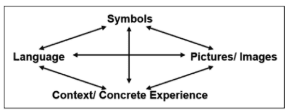
We approached this development cycle with the understanding that mathematical thinking develops through lived experiences, language and context. This aligned closely with mathematics frameworks of Haylock & Cockburn (1989) (Figure 1), whose connective model emphasises the importance of linking concrete experience, imagery and language to support children in forming deep conceptual structures. Williams’ (2022) work on representational fluency further shaped our approach, highlighting how children must move flexibly between concrete, pictorial and abstract forms to generalise ideas and build secure number sense.
Figure 1: The Connective Model (Haylock and Cockburn, 2004). A framework used to support the pedagogical vision for changes in practice within KS1.
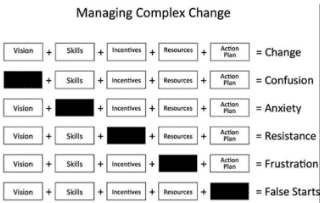
Alongside these mathematical pedagogical foundations, we drew on implementation discourses to guide the leadership process. Schein (2016) foregrounds the role of humble inquiry, noting the importance of leading through curiosity rather than expertise, while Knoster (1991) provides a practical model for managing complex change, emphasising clarity of vision, skills, incentives, resources and action planning (Figure 2).
Figure 2: The Knoster Model for Managing Complex Change (Knoster, 1991). The theoretical framework used to critically support and quality assure the change management process.
Underpinned by the EEF (2024) guidance on implementation, these frameworks enabled us to design a cycle of change that supported both pedagogical development and leadership capacity, ensuring that changes to practice were coherent, feasible and sustainable. Working collaboratively with the school’s maths lead and senior leadership team enabled us to explore the problem rigorously while keeping teachers’ and children’s lived experiences at the centre.
Our curriculum and pedagogical innovation
The school identified a need to strengthen number fluency, deepen conceptual understanding and reduce overreliance on worksheets in KS1. The change process began by diagnosing the current context through staff questionnaires, which revealed that teachers felt overwhelmed by the volume of WRM small steps, uncertain about how to adapt lessons, and unsure how to integrate manipulatives and play-based learning meaningfully. Pupil voice conferences and observations further highlighted that children associated mathematics primarily with worksheets and struggled to articulate key concepts such as repeated addition, grouping and fractions.
These findings suggested that the issue lay not necessarily within the WRM materials themselves, but in how the curriculum was being interpreted and enacted within classrooms. Consequently, leaders recognised the need to:
- streamline the KS1 curriculum
- prioritise core concepts
- strengthen representational understanding
- embed mathematical thinking within continuous provision
- build teacher confidence in adapting materials
This aligned with the school’s broader pedagogical shift and provided a clear rationale for developing a KS1 Pedagogy on a Page, which became a shared, research-informed framework articulating how mathematical thinking would be nurtured through play with mathematics teaching and learning.
Implementation cycle
The inquiry unfolded across three iterative cycles, each informed by the EEF’s A School’s Guide to Implementation (2024) and grounded in diagnostic evidence.
Cycle 1: Understanding the problem
This phase involved:
- learning walks across EYFS and KS1
- staff questionnaires
- book looks
- pupil voice conferences and observations
Based on this evidence, we conducted a joint SWOT (Strengths, Weaknesses, Opportunities, Threats) analysis. Key insights included:
- significant variation in the use of representations
- heavy reliance on worksheets
- limited opportunities for mathematical talk
- a disconnect between the play-based ethos, continuous provision and KS1 practice
- confusion among staff about how to adapt WRM without losing structure
This diagnostic work strengthened the maths lead’s capacity to ‘engage, unite and reflect’ (EEF, 2024), enabling a clearer articulation of the problem, definition and rationale for change.
Cycle 2: Designing the pedagogical framework
Working collaboratively, we developed the KS1 Pedagogy on a Page, structured around four components. This was inspired by previous phase CPD around developing play-based approaches and practices within KS1, delivered by Greg Botrill, and developing his work around play projects:
- Make & Create: concrete exploration
- Build: spatial and structural reasoning
- Draw: pictorial representation
- Message: symbolic and abstract recording
This framework drew on:
- Concrete-Pictorial-Abstract (CPA) progression (Bruner, 1966; Haylock & Cockburn, 2008)
- representational fluency (Williams, 2022)
- sociocultural learning theory (Vygotsky, 1978)
- the school’s commitment to developing continuous provision into KS1
We then adapted the KS1 mathematics curriculum, prioritising core concepts, and designing weekly provision enhancements aligned with mathematical structures.
Cycle 3: Implementing and refining the approach
This phase included:
- collaborative planning sessions with KS1 staff
- pupil conferences and observation to evaluate conceptual understanding
- refinement of the adapted mathematics curriculum based on staff feedback
Through the collaborative work between the School Development Lead (SDL) and the maths lead, we began to see a noticeable shift in the leadership behaviours shaping the initiative. Our joint approach created the conditions for diagnosis of the context’s need with increasing precision, sequence change more strategically, and leading pedagogical dialogue with growing confidence. These developments reflected not only emerging leadership capacity but also the intentional structures, coaching and inquiry stance embedded within the SDL role. Together, this partnership exemplified the kind of sustainable leadership growth described by Papay and Kraft (2016) and the adaptive, capacity-building change processes advocated by Fullan (2002).
How the approach was evaluated
A wide range of evidence informed this cycle of change, enabling a rich understanding of both practice and experience across the school. Data sources included field notes from learning walks, staff questionnaires capturing perceptions of the existing scheme and pedagogical challenges, and pupil voice transcripts and observations that illuminated how children were making sense of mathematical ideas. Planning documentation and adapted curriculum materials provided insight into how teachers were interpreting and enacting the revised approach, while the maths lead’s implementation plan offered a window into the developing strategic thinking underpinning the work. Alongside this, reflective journalling by the SDL supported ongoing analysis and sense-making, enabling patterns, tensions and emerging insights to be captured over time. The triangulation of these sources, drawing on the principles outlined by Denscombe (2017) and Cohen et al. (2018), strengthened the validityIn assessment, the degree to which a particular assessment measures what it is intended to measure, and the extent to which proposed interpretations and uses are justified of the findings and ensured that both staff and children’s voices shaped each stage of the process.
Findings and implications
This process remains ongoing, with next steps already being developed by the school based on the emerging themes.
1. Play-based pedagogy strengthened conceptual understanding
Children demonstrated improved ability to:
- explain grouping and sharing using manipulatives
- connect repeated addition to multiplication
- articulate fractions using meaningful contexts (e.g., café role play)
Pupil voice showed increased confidence and enjoyment, with children referencing play-based experiences rather than worksheets when describing their learning.
2. Representational variation improved retention
The Make–Build–Draw–Message structure supported children to move flexibly between concrete, pictorial and abstract representations. This aligns with Williams’ (2022) argument that representational variety is essential for generalisation.
3. Leadership capacity grew significantly
The mathematics lead:
- moved towards leading the implementation plan independently
- facilitated KS1 planning sessions
- drew upon theoretical frameworks to anticipate staff needs, such as ‘The Knoster Model for Managing Complex Change’ (Knoster 1991)
- articulated a coherent pedagogical narrative across KS1 (which is now being considered for KS2)
This shift towards leadership agency reflects Schein’s (2016) principles of humble inquiry and the EEF’s (2024) emphasis on building leadership capacity.
4. Curriculum adaptation reduced cognitive overload
Streamlining the mathematics curriculum created:
- increased depth of learning
- clearer expectations for staff
- improved alignment with continuous provision
- greater professional autonomy
Teachers reported feeling ‘freer to teach the maths, not the worksheet’.
5. Cultural coherence strengthened across phases
The inquiry revealed that KS1 pedagogy has already begun to influence thinking and consideration for implementation within KS2, particularly around representation and mathematical talk. This suggests early signs of sustainable cultural change across the whole school.
Recommendations for practitioners
Based on this inquiry, we offer the following recommendations:
- Begin with diagnostic inquiry, not solutions
Use learning walks, staff voice and pupil voice to understand the lived experience of mathematics. Focusing this initial diagnostic exploration on capturing the voice of the setting’s stakeholders creates a baseline picture that is meaningful and relevant to the context.
- Develop a shared pedagogical spine
A simple, research-informed framework, such as Pedagogy on a Page, supports coherence and professional autonomy.
- Prioritise representational fluency
Ensure children experience concepts through multiple, connected representations before abstract recording. Play is, and should be, a vehicle to facilitate this, ensuring that learning experiences respect children’s development.
- Align continuous provision with mathematical structures
Provision enhancements should reflect the week’s core concept and avoid becoming generic mathematics areas. Best practice would make these responsive to the children’s interests.
- Build leadership capacity deliberately
Use coaching, modelling and joint analysis to support leaders to diagnose, plan and communicate effectively. Make space to understand emerging challenges and consider how local solutions can overcome these.
- Use pupil voice as a diagnostic tool
Children’s explanations reveal conceptual gaps that worksheets often mask. Create opportunities for them to show their mathematics thinking and reasoning in action, to understand how they experience becoming mathematicians within your classrooms.
References
Bruner J. S (1966) Toward a theory of instruction. Harvard University Press
Cohen L, Manion L and Morrison K (2018) Research Methods in Education. London: Routledge.
Denscombe M (2017) The good research guide for small-scale social research projects. London: Open University Press.
Education Endowment Foundation [EEF] (2024) A School’s Guide to Implementation: Guidance Report. London: Education Endowment Foundation.
Fullan, M (2002) The Change Leader. Educational Leadership, 59(8), 16–20.
Haylock D and Cockburn A (1989) Understanding Early Years Mathematics. London: Sage Publications.
Knoster T (1991) Presentation at the TASH Conference. Washington, D.C.
Papay J.P and Kraft M (2016) The Myth of the Performance Plateau. Educational Leadership, 73(8), 36-42.
Schein E. H (1990) A general philosophy of helping: Process consultation. Sloan Management Review, 31(3), 57-64.
Vygotsky L.S (1978) Mind in society: The development of higher psychological processes. London: Harvard University Press
Williams H (2022) Playful Mathematics. London: Sage Publications.
Copyright: Ashley Pearce and Rebekah Gear, 2026. This work is licensed under a Creative Commons Attribution‑NoDerivatives (CC BY‑ND) licence.
When citing this resource, please use the following citation: Pearce A and Gear R (2026). Pedagogy on a Page. Derby: Brookfield Primary School