
DR VICKY YIRAN ZHAO, TEACHER OF MATHS, TRUMPINGTON COMMUNITY COLLEGE (PART OF UNITED LEARNING, UK); AFFILIATE RESEARCHER, UNIVERSITY OF CAMBRIDGE, UK
Introduction
Play, defined by Burghardt (2006), is partially functional but not purposeless, spontaneous yet modified from more serious behaviours, repeated without compulsion, and carried out in psychologically and physically safe contexts. Thus, playful learning is defined as active, socially interactive, meaningful, iterative and joyful (Zosh et al., 2018).
This case study explores a maths enrichment club with 67 per cent of attendees eligible for pupil premiumAdditional funding for publicly funded schools in England to raise the attainment of disadvantaged pupils of all abilities (PP), investigating how play can be reintroduced into secondary mathematics to widen participation for students who are often underrepresented in enrichment. Although the project was not designed or statistically powered to compare outcomes between disadvantaged and non-disadvantaged pupils, equity considerations informed its design. By embedding agency, exploration and collaboration into mathematics, the club sought to improve engagement and instil belonging and confidence for those who often feel excluded from enrichment (Aguirre et al., 2013). In this way, playful pedagogy is framed not as an option but as an equity strategy.
Context
Maths circles refer to enrichment activities that promote mathematical exploration and discussion in small and collaborative settings. A good example of this is the Axiom Maths Circle, which promotes the participation of high-attaining PP pupils (Axiom Maths, nd). In my school, lower prior-attaining PP students tend to engage far less with subject-specific extra-curricular opportunities. Thus, my school adapted this model to widen participation and promote inclusionAn approach where a school aims to ensure that all children are educated together, with support for those who require it to access the full curriculum and contribute to and participate in all aspects of school life by inviting PP participants from middle to lower sets.
A key innovation was introducing peer scaffoldingProgressively introducing students to new concepts to support their learning, where Year 11 students act as co-facilitators alongside the teacher, supporting younger learners and modelling mathematical reasoning. This approach expanded the circle capacity. Instead of a single circle of six students, five simultaneous circles were run within one session, accommodating up to 30 students and enabling learners of different ages and attainment levels to collaborate.
The studied sessions ran for one month, with hour‑long sessions each week during lunchtime to maximise attendance. A total of 13 students participated: eight Year 8s (five PP students) and five Year 11s.
Sessions focused on cryptarithmetic puzzles. They started with simple digit-based puzzles and progressed to letter-based challenges of increasing complexity, culminating in a classic alphametic problem requiring multi-step reasoning (Figure 1). To promote agency and collaboration, students were also invited to create their own puzzles and test them on peers.

Figure 1: Cryptarithmetic puzzles
The intervention was deliberately structured around six dimensions of playful learning (LEGO Foundation, 2022). Agency was fostered by giving students freedom to choose approaches and when to seek support. Year 11s reinforced this by prompting Year 8s to explain their reasoning rather than simply following instructions. Exploration was embedded through cryptarithmetic tasks presented without worked examples, encouraging experimentation and multiple pathways. Problem-solving was central, with low‑floor, high‑ceiling challenges that demanded persistence. Hints were offered sparingly so that students experienced the productive struggle of getting stuck and unstuck. Connection to experience came through links to familiar contexts, such as codes and everyday number patterns. Social interaction was integral throughout: small groups explained ideas, debated strategies and engaged in reciprocal scaffolding, with Year 11s modelling mathematical language and Year 8s contributing creative approaches. Finally, the sessions cultivated a positive climate by emphasising joy, curiosity and risk‑free participation. Mistakes were reframed as opportunities for insight, successes were celebrated collectively and both teacher and mentors responded to students’ emotions to ensure that all felt safe and included.
Data collection combined quantitative surveys adapted from the Engage Toolkit (LEGO Foundation, 2022) with qualitative focus group interviews of 13 participants. This mixed‑methods design allowed triangulation of socio‑emotional and cognitive outcomes.
Results
Survey data showed consistently high ratings across dimensions (based on a Likert scale, with 1 being ‘strongly disagree’ and 5 being ‘strongly agree’), confirming perceptions of a supportive, collaborative environment. Year 11s rated connection to experience significantly higher, reflecting mentoring’s role in linking ideas through explanation (Figure 2). Year 8s rated exploration slightly higher, consistent with their enjoyment of trial and error.
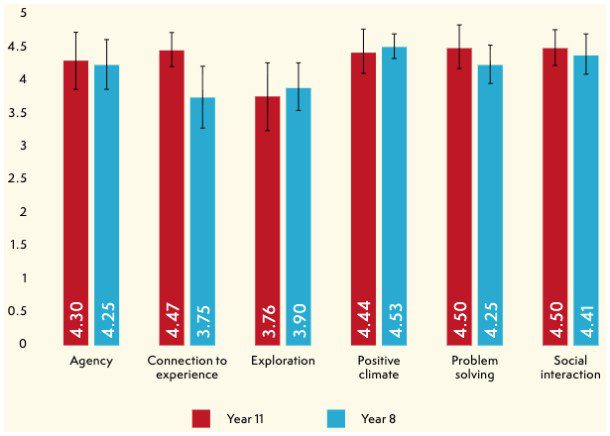
Figure 2: Mean score across six dimensions of playful learning outcomes (adapted from the Engage Toolkit)
Item‑level patterns sharpened interpretation. Year 8s strongly endorsed items signalling safe, enjoyable climate and supported problem-solving, while Year 11s emphasised agency and belonging in their mentoring role. Lower ratings for mentor‑led exploration suggest that while older students felt effective, they had less opportunity to redesign tasks.
Focus group findings reinforced these themes. The puzzles were enjoyable precisely because they were difficult and lacked obvious algorithms, which encouraged ‘working mathematically’ rather than applying memorised procedures. One Year 8 explained: ‘It was hard, but that made me want to carry on because I wanted to solve it more.’ Another added: ‘It doesn’t require me to get it right immediately. It encourages me to think outside of the box rather than inside.’ Exploration was central, as noted by one Year 11: ‘It made me broaden my horizons and try new stuff.’ Collaboration was described as epistemic: ‘I liked when someone got something wrong and someone else had to explain why… it felt very intellectual.’
Mentoring added distinctive mechanisms. A Year 8 captured complementary cognition: ‘They support things that I wouldn’t spot… but they also miss out things.’ Younger pupils contributed intuitive moves, older students offered structure and strategy, and together they increased the chance of insight. Mentoring also created low‑stakes explanation practice, forcing Year 11s to clarify reasoning. Several admitted difficulty: ‘Whenever I work it out in my head, the steps are blurry… explaining means it has to be concise, which is hard.’ Yet this struggle sharpened communication. Mentoring also changed status dynamics, making struggle socially safe, and built productive responsibility: older students persisted not only for themselves but also for their mentees. One reflected: ‘It was humbling… sometimes they [Year 8s] got it faster than I did.’
Students also highlighted a positive climate and emotional safety. Mistakes were reframed as normal, reducing shame and increasing confidence. One Year 8 explained: ‘If it’s a small mistake, it doesn’t matter… I can just go back and fix it.’ Yet Year 11s acknowledged exam pressures as a constraint, recognising that playful learning may be squeezed by assessment structures: ‘I hope we get to have these opportunities in lessons… but with GCSEs approaching, it might not be practical.’
Conclusion
The findings demonstrate that playful learning can be both feasible and transformative in secondary mathematics. The six dimensions of play were consistently experienced by students, showing that cryptarithmetic puzzles and peer scaffolding operationalised theoretical principles in practice. Agency and exploration challenged the rigidity of traditional lessons, while problem-solving and connection to experience highlighted the relevance of mathematics beyond exams. Social interaction and positive climate underscored the importance of community and emotional safety.
The small sample size of PP students suggests that the study could not examine differences in the experience by PP status. Therefore, the reflections described here represent the whole group rather than a specific subset. Pupils valued the chance to ‘get stuck safely’ without fear of failure, and to contribute creative approaches alongside peers. Mentoring further amplified benefits: younger students contributed intuitive insights that older students sometimes overlooked, while older students offered structured strategies. This reciprocity ensured that younger pupils, including those often underrepresented in enrichment activities, were not positioned as recipients of help but as contributors to collective problem-solving.
The Zone of Proximal Development (Vygotsky, 1978) suggests that students extended their capacity through scaffolding, while also scaffolding others. Both Year 8s and Year 11s were legitimate participants in mathematical discourse, and not marginal observers. Similarly, flow (Csikszentmihalyi, 1997) was evident when participants described moments of deep absorption and persisting through difficulty.
The recognition of exam pressures by Year 11s highlights the structural tension between playful learning and assessment regimes. This tension suggests that playful approaches should complement, rather than replace, traditional instruction. By embedding play alongside exam preparation, schools can cultivate both the resilience needed for assessments and the curiosity that sustains lifelong mathematical engagement.
This case study shows that play-based pedagogy can reimagine secondary mathematics as a space for curiosity, collaboration and resilience. Through cross-year mentoring, the maths circle created conditions where challenge was motivating, mistakes were normalised and belonging strengthened. Although not analysed by disadvantage status, several pupils underrepresented in enrichment described meaningful gains in confidence and engagement. Overall, the study demonstrates that play can be integrated into secondary maths when balanced with accountability.