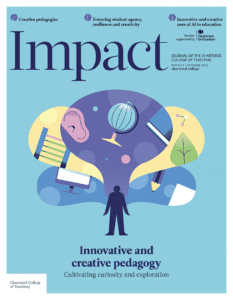

Featured image source: David Man & Tristan Ferne / https://betterimagesofai.org / https://creativecommons.org/licenses/by/4.0/
CAT RUSHTON, DIRECTOR OF INSTITUTE, ACADEMY TRANSFORMATION TRUST, UK
Introduction
As the education system becomes accustomed to a world in which both teachers and students routinely use AI (artificial intelligence), educators are increasingly aware of its transformative potential, alongside the risks that it presents. To date, government policy and much of the sector’s conversation have focused primarily on safe use, addressing concerns such as harm prevention, compliance and security (DfE, 2025a). While these issues are essential, they represent only the starting point. A more expansive and nuanced conversation is now required to understand how AI may fundamentally reshape teaching, learning and professional practice in schools.
Moving beyond a narrow focus on safety and compliance, attention must turn to the responsible pedagogical use of AI, grounded in professional judgement and an ethical, fair and socially beneficial approach. This dimension of AI’s impact on schools is often framed in terms of student ‘overreliance’ or concerns that deeper learning may be bypassed (DfE, 2025a). However, the challenge is far more profound.
Conflating the AI conversation
Much of the current conversation around AI tends to conflate its integration into schools as a single issue. This approach often obscures the nuanced complexities involved in different types of AI use. In reality, distinct areas of application carry significantly different risks and benefits. To address this, a three-part framework for AI integration in schools is proposed, which separates AI considerations into three categories: productivity, planning and preparation, and pedagogy.
A three-category framework for implementing AI
Productivity
Teachers spend an estimated five hours per week on administrative tasks (Bryant et al., 2020), and schools employ substantial numbers of support staff to manage the considerable workload required for the effective operation of educational settings. AI has the potential to automate large portions of routine administrative activity, reducing overall burden across the sector and freeing up time and capacity (DfE, 2025b). This would allow both teachers and support staff to focus on higher-value tasks, enhancing efficiency and enabling more time to be devoted to the uniquely human elements of education.
For use cases in this category, school leaders are encouraged to actively promote AI use to realise its most immediate, straightforward and tangible benefits. The primary risks associated with staff use for productivity relate to safe practice, which can be mitigated through robust training and awareness focused on GDPR (General Data Protection Regulation) compliance.
Planning and preparation
Teachers spend over ten hours per week on ‘preparation’ and around six on ‘evaluation and feedback’ (Bryant et al., 2020), totalling 17 hours on the creation of lesson materials and the ongoing evaluation and feedback necessary to ensure that teaching is responsive to students and supports their learning over time.
The Education Endowment Foundation (EEF, 2024) found that teachers can reduce the time spent on resource creation by 31 per cent through using generative AI (GenAI), while the study found no evidence of negative impact on the quality of the resources produced. Therefore, integrating AI into planning offers teachers opportunities to shift time away from routine resource generation towards deeper intellectual engagement with lesson content. However, Selwyn et al. (2025) note that teachers often encounter the ‘limits of GenAI output’, meaning that materials still require careful analysis and significant adaptation (p. 313).
Beyond supporting lesson planning, AI is increasingly being leveraged to gather insights into student learning and to deliver timely, personalised feedback. A meta-analysis comparing the impact of AI-generated versus human-generated feedback on students’ learning outcomes and perceptions of feedback found no statistically significant differences (Kaliisa et al., 2025), although individual studies showed mixed effects. AI could demonstrate significant potential in this area, enabling faster feedback cycles and scaling personalised responses beyond what individual teachers can achieve. However, it should not be regarded as a universal solution; effective hybrid human–AI systems are essential to ensure that contextual factors are addressed, and that uniquely human qualities, such as empathy and professional pedagogical judgement, are integrated into feedback processes (Molenaar, 2022).
Using AI to expedite planning, support the generation of insights about learning and scale personalised feedback has the potential to refocus teachers on pedagogical thinking and enable them to arrive at lessons with a more secure grasp of subject content and students’ starting points. This, in turn, can strengthen teachers’ readiness for adaptive teaching, supporting more responsive and creative solutions to students’ needs. With adaptive practice marking a significant advance in creating more inclusive classrooms, the cognitive space for teachers to adjust teaching in response to learner needs, with an emphasis on real-time decision-making, has the potential to enhance teaching practices (Leswell, 2023).
A recent research paper from Ofsted (2025) noted that many leaders see AI as a way in which to adapt and personalise resources, making lessons more accessible for diverse learners, including those with special educational needs and English as an additional language. However, there is limited research on how best to achieve this, and it raises an important tension: while the sector is moving from ‘differentiation’ towards ‘adaptive teaching’, using AI to proactively adjust curriculum, methods and resources still relies on fixed categories and predetermined activities. This limits flexibility and risks overlooking learners’ evolving needs during a lesson and lowering expectations around some students (Leswell, 2023).
When considering use cases in this category, teachers and leaders are encouraged to actively explore the opportunities presented by AI, leveraging professional expertise to critically evaluate and interrogate AI-generated outputs and their impact on learning. Small-scale pilots can help to determine what works in specific contexts, phases and subject specialisms. Teacher professional judgement is essential, and it is important to resist the temptation to defer to AI for all the answers. The main risks here relate to overreliance on AI, which could undermine teacher expertise, autonomy and creativity, particularly for those new to the profession. To address this, teachers need professional development opportunities that build understanding of AI, while providing structured opportunities for peer collaboration and evaluation of AI tools that can support planning and preparation in their specific contexts.
Pedagogy
Here we explore the complex and controversial topic of AI’s integration into the classroom itself, considering the concept of students themselves using AI tools as part of the learning process. This moves away from what are considered ‘teacher-facing AI tools’ and towards what are described as ‘learner-facing AI tools’. Direct student access to AI in lessons remains relatively uncommon across the sector. Predictably, independent student use is more frequent in secondary and further education settings, reflecting the greater maturity of learners. Interestingly, reports indicate that students use AI more extensively than their teachers, highlighting the urgent need for the sector to keep pace with the rapid changes occurring around it (Ofsted, 2025).
While pupil-facing AI has the potential to enhance learning, it also poses significant risks by encouraging cognitive shortcuts and gamification of learning processes and diminishing critical thinking. Easy access to AI increases the likelihood of students relying on it for essays, coding or problem-solving, which can hinder the development of creativity, reasoning and long-term knowledge retention. This raises urgent questions about its impact on essential learning skills, particularly given the limited clarity around which applications genuinely support learning and which may undermine fundamental human capacities (Mustafa et al., 2024).
This uncertainty is amplified by the fact that evidence to date comes from short-term studies, providing limited insight into long-term effects. However, some concerning findings are beginning to emerge. For example, a study on students using large language models for essay writing suggests that they may engage less deeply with the material, therefore focusing on a narrower set of ideas. This pattern could contribute to the accumulation of ‘cognitive debt’, where mental effort is deferred in the short term, potentially affecting the long-term development of critical thinking, creativity and deep learning (Kosmyna et al., 2025).
Teaching students about AI is also an important consideration, and curriculum development is needed to ensure that they understand how AI works, its biases, risks of misinformation and how it processes data, providing pupils with essential AI literacy in a digital world. Crucially, however, developing student digital literacy should not be equated with allowing digital tools to dominate the curriculum. Traditional teaching methods and learning activities remain vital for equipping students with the skills with which to critically evaluate AI outputs, a key human competency in an increasingly automated world.
When considering use cases in this category, AI should be approached with caution. Classrooms provide weak feedback on whether new approaches truly enhance learning, and the long-term implications of AI use for students remain unknown. The risks here are potentially the most profound, with consequences that may extend far into the future, shaping the world citizens of tomorrow. Professional development is therefore essential, equipping teachers and leaders to exercise informed professional judgement when guiding student interactions with AI. These decisions should be grounded in the established principles of the science of learning, postponing student use of AI in the learning process until they have developed sufficient subject knowledge and AI literacy to support deep, independent learning.
Conclusion
In conclusion, the integration of AI into schools represents both unprecedented opportunities and profound challenges. Across productivity, planning and pedagogy, AI has the potential to free teachers from routine tasks, enhance lesson preparation and provide insights that support more personalised and adaptive teaching. However, these benefits are dependent on careful implementation, underpinned by professional judgement, robust training and an awareness of the risks of overreliance or superficial engagement. Particularly in the classroom, where students themselves may interact with AI, there is a pressing need to balance technological innovation with the preservation of core human competencies, such as critical thinking, creativity and problem-solving. As the evidence base is still emerging, and long-term impacts remain largely unknown, schools must approach AI integration deliberately, guided by the principles of the science of learning. Ultimately, the goal is not to let AI replace essential aspects of teaching and learning, but to strategically harness it in ways that amplify human expertise, enhance student learning and prepare young people to thrive as capable, thoughtful citizens in an increasingly AI-infused world.
The examples of AI use and specific tools in this article are for context only. They do not imply endorsement or recommendation of any particular tool or approach by the Department for Education or the Chartered College of Teaching and any views stated are those of the individual. Any use of AI also needs to be carefully planned, and what is appropriate in one setting may not be elsewhere. You should always follow the DfE’s Generative AI In Education policy position and product safety standards in addition to aligning any AI use with the DfE’s latest Keeping Children Safe in Education guidance. You can also find teacher and leader toolkits on gov.uk.